
The hardware and bandwidth for this mirror is donated by dogado GmbH, the Webhosting and Full Service-Cloud Provider. Check out our Wordpress Tutorial.
If you wish to report a bug, or if you are interested in having us mirror your free-software or open-source project, please feel free to contact us at mirror[@]dogado.de.
Vertex pool topology for geometry handled by wk.
Simple features throws away topology — every polygon stores its own coordinates, shared boundaries are duplicated, and expensive operations (GEOS) are needed to rediscover this structure which is then again discarded.
wkpool takes a different approach:
.vx).establish_topology() represents the truth of your input.
Snapping/fixing is a separate, explicit decision.merge_coincident() finds shared vertices. Shared
boundaries, neighbour relations — they emerge from the data..feature), enabling adjacency and boundary
queries.From CRAN use
install.packages("wkpool")For development version use
#install.packages("remotes")
remotes::install_github("hypertidy/wkpool")library(wkpool)
library(wk)
# Any wk-handleable geometry
#x <- wk::as_wkb(<wk-compatible>)
x <- wk::as_wkb(c(
paste0(
"MULTIPOLYGON (((0 0, 0 1, 0.75 1, 1 0.8, 0.5 0.7, ",
"0.8 0.6, 0.69 0, 0 0), (0.2 0.2, 0.5 0.2, ",
"0.5 0.4, 0.3 0.6, 0.2 0.4, 0.2 0.2)))"),
"MULTIPOLYGON (((0.69 0, 0.8 0.6, 1.1 0.63, 1.23 0.3, 0.69 0)))"
))
# Establish topology (no coordinate merging yet)
pool <- establish_topology(x)
# What do we have?
topology_report(pool)
#> $n_vertices_raw
#> [1] 19
#>
#> $n_vertices_unique
#> [1] 14
#>
#> $n_duplicate_vertices
#> [1] 5
#>
#> $n_near_miss_vertices
#> [1] 0
#>
#> $n_segments
#> [1] 16
#>
#> $n_shared_edges
#> [1] 1
#>
#> $n_features
#> [1] 2
# Merge coincident vertices (exact match)
merged <- merge_coincident(pool, tolerance = 0)
# Find shared boundaries
shared <- find_shared_edges(merged)
# Internal boundaries (edges shared by exactly 2 features)
internal <- find_internal_boundaries(merged)
# Neighbour relations
neighbours <- find_neighbours(merged, type = "edge") # share a boundary
neighbours_v <- find_neighbours(merged, type = "vertex") # share any vertex
# Access the raw structure
pool_vertices(merged) # data.frame: .vx, x, y
#> .vx x y
#> 1 1 0.00 0.00
#> 2 2 0.00 1.00
#> 3 3 0.75 1.00
#> 4 4 1.00 0.80
#> 5 5 0.50 0.70
#> 6 6 0.80 0.60
#> 7 7 0.69 0.00
#> 9 8 0.20 0.20
#> 10 9 0.50 0.20
#> 11 10 0.50 0.40
#> 12 11 0.30 0.60
#> 13 12 0.20 0.40
#> 17 13 1.10 0.63
#> 18 14 1.23 0.30
pool_segments(merged) # data.frame: .vx0, .vx1, .feature
#> .vx0 .vx1 .feature .path
#> 1 1 2 1 1
#> 2 2 3 1 1
#> 3 3 4 1 1
#> 4 4 5 1 1
#> 5 5 6 1 1
#> 6 6 7 1 1
#> 7 7 1 1 1
#> 8 8 9 1 2
#> 9 9 10 1 2
#> 10 10 11 1 2
#> 11 11 12 1 2
#> 12 12 8 1 2
#> 13 7 6 2 3
#> 14 6 13 2 3
#> 15 13 14 2 3
#> 16 14 7 2 3inlandwaters (in silicate) has six features with 189
rings, 32 of them holes, and neighbouring states that share long
boundaries vertex for vertex. After merge_coincident()
those boundaries are the same vertex pairs, so the quotient graph walks
each shared boundary once:
x <- wk::as_wkb(sf::st_geometry(silicate::inlandwaters))
pool <- merge_coincident(establish_topology(x))
find_arcs(pool, quotient = TRUE)    # 201 arcs
find_nodes(pool, quotient = TRUE)   # 13 nodes where three or more edges meet
classify_cycles(pool)               # 189 rings: 157 outer, 32 holes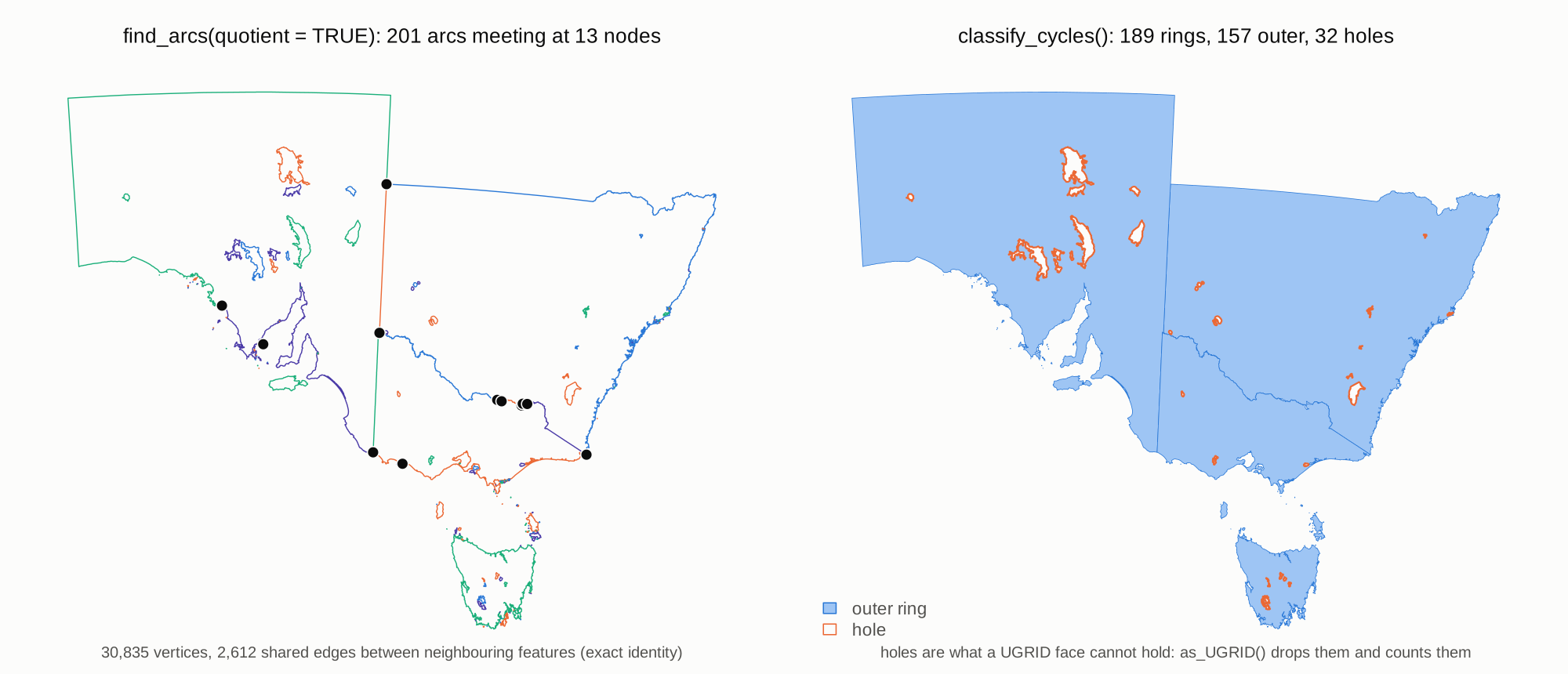
Without quotient = TRUE every vertex inside a shared
boundary has degree 4 (each feature carries its own copy of the edge),
so find_nodes() returns 2,619 nodes and
find_arcs() 5,418 arcs. Use the quotient graph for
coverages; the default counts every segment.
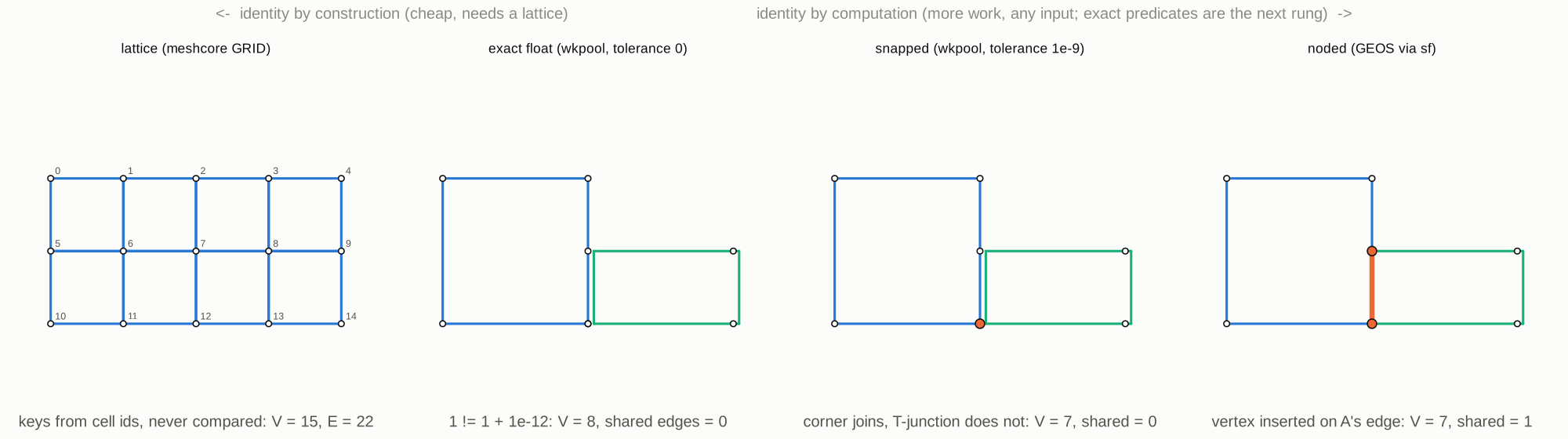
wkpool covers two rungs of a ladder of ways a vertex can be “the
same”: exact float (merge_coincident(tolerance = 0)) and
snapped (tolerance > 0). It does not node: a vertex
lying on another feature’s edge stays a T-junction until something like
GEOS inserts it. Above exact float, a lattice (a raster, a discrete
global grid) can give identity by construction, with no comparison at
all.
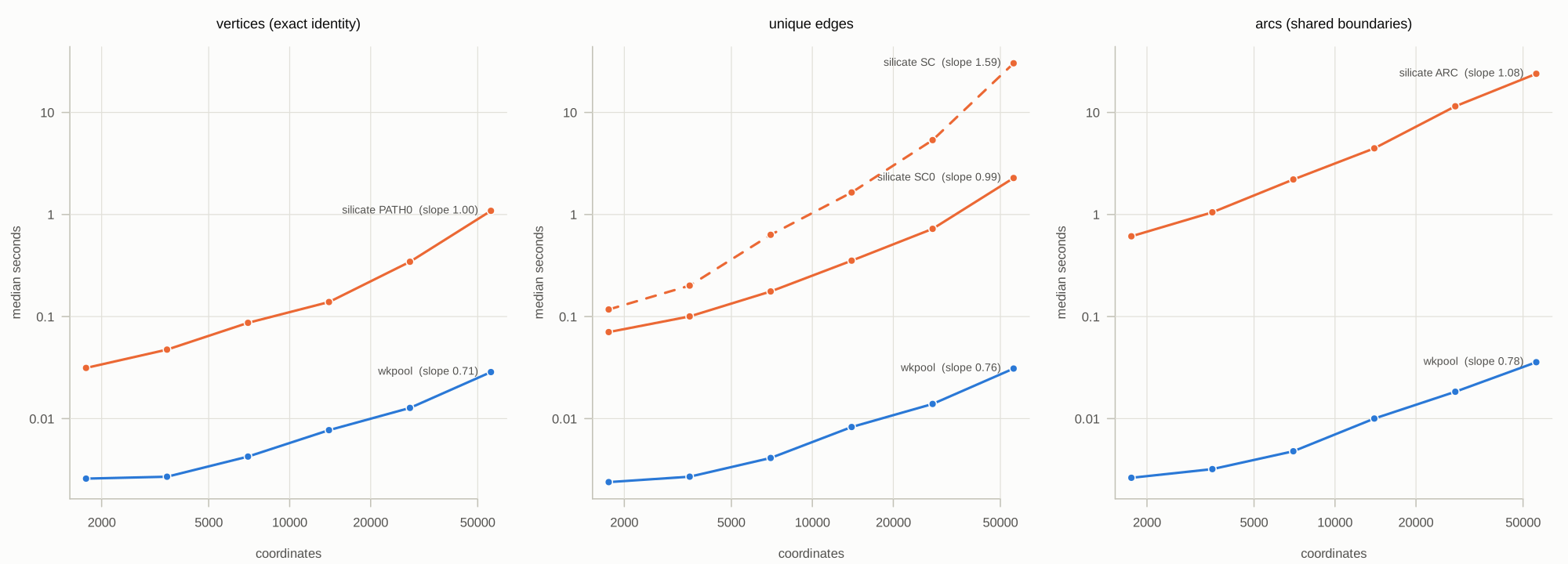
All pipelines scale linearly. Against silicate on the same inputs
(bench/README.md has the full tables), wkpool is 1.6 to 29
times faster than PATH0() for vertices and 12 to 1300 times
faster than SC() and ARC() for edges and
arcs.
wkpool is machinery: silicate’s models and sc_* verbs
can sit on it, and so can other mesh models. Work in progress on top of
it:
silicate2: the UGRID model and a model zoo, with polygons
and lines routed into UGRID through wkpool.as_wkpool() hands over an already-merged pool.| Decision | Choice | Rationale |
|---|---|---|
| Pool scope | Per-vector, sidecar attribute | No wk core changes needed, n-geometry ready |
| Snapping | Observe don’t correct | Represent truth, fixing is separate |
| Vertex identity | Minted .vx integer |
Survives subset, lighter than UUID |
| Segment identity | Derived from vertex pair | No ID to track, tuple IS identity |
| Primary vctr | Segments | Geometry is what you subset, vertices follow |
| Foundation | vctrs | Principled combine/subset, tidyverse alignment |
Please note that the wkpool project is released with a Contributor Code of Conduct. By contributing to this project, you agree to abide by its terms.
These binaries (installable software) and packages are in development.
They may not be fully stable and should be used with caution. We make no claims about them.
Health stats visible at Monitor.