
The hardware and bandwidth for this mirror is donated by dogado GmbH, the Webhosting and Full Service-Cloud Provider. Check out our Wordpress Tutorial.
If you wish to report a bug, or if you are interested in having us mirror your free-software or open-source project, please feel free to contact us at mirror[@]dogado.de.






A production-grade vehicle routing problem (VRP) solver for R.
vrpr brings the state-of-the-art PyVRP solver to R. It vendors PyVRP’s high-performance C++ core and rewires it with cpp11, wrapped in an idiomatic, tidyverse-style API: a pipe-friendly model builder, data in tibbles, and logging via cli — with no Python runtime dependency.
It fills a real gap in the R ecosystem: there are ompr,
ROI, lpSolve, igraph and
dodgr, but no modern, strong, friendly solver for
production vehicle routing.
tools/benchmark/).Install the released version from CRAN:
install.packages("vrpr")Or the development version from GitHub:
# install.packages("pak")
pak::pak("StrategicProjects/vrpr")
A C++20 toolchain is required to build from source (R >= 4.3).
library(vrpr)

clients <- tibble::tibble(
  x = c(10, 25, 40, 15), y = c(5, 30, 12, 22),
  demand = c(10, 15, 8, 12)
)

res <- vrp_model() |>
  add_depot(x = 0, y = 0) |>
  add_clients(clients) |>
  add_vehicle_type(num_available = 3, capacity = 50) |>
  vrp_solve(stop = max_runtime(2))

cost(res)      # objective cost
routes(res)    # tibble: route_id, depot, position, client, vehicle_type, ...
summary(res)   # one-row summary
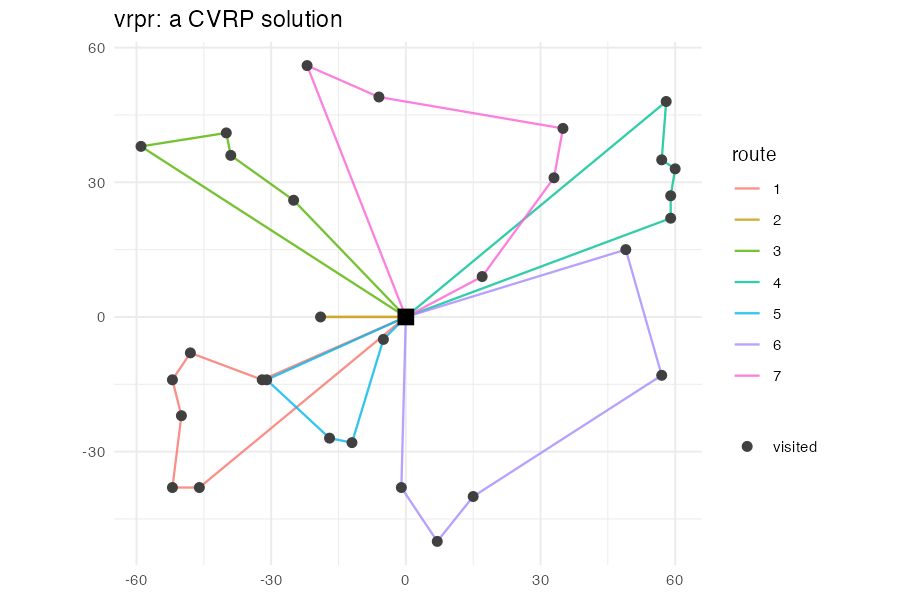
plot(res) # the routes, with {ggplot2}| Variant | How |
|---|---|
| Time windows (VRPTW) | add tw_early, tw_late,
service to clients |
| Heterogeneous fleet | call add_vehicle_type() several times with different
capacities/costs |
| Multiple depots (MDVRP) | several add_depot() +
add_vehicle_type(depot = i) |
| Prize-collecting | required = FALSE + prize on clients;
add_client_group() for exclusive sets |
| Pickup & delivery / backhaul | add a pickup column to clients |
| Paired pickup-and-delivery (PDP) | add_shipments() with pickup/delivery points |
| Multi-trip | add_vehicle_type(reload_depots = i, max_reloads = k) |
See the Getting started guide and the Articles for worked examples of each.
m <- read_vrplib(system.file("extdata", "sample-n6-k2.vrp", package = "vrpr"))
m <- read_solomon(system.file("extdata", "sample-solomon.txt", package = "vrpr"))
res <- m |> vrp_solve(stop = max_runtime(5))

vrpr is a thin, idiomatic R skin over PyVRP’s C++
engine:
vrp_solve().IteratedLocalSearch.src/vendor/pyvrp/, version pinned in
tools/PYVRP_VERSION) — the hot compute: problem data, cost
evaluation, solutions and the local-search operators.The light R loop drives the heavy C++ search, so you get PyVRP-grade performance with a pure-R, Python-free workflow.
MIT. Derived from PyVRP (© PyVRP contributors, Thibaut Vidal, ORTEC),
whose copyright is preserved; see inst/COPYRIGHTS.
These binaries (installable software) and packages are in development.
They may not be fully stable and should be used with caution. We make no claims about them.
Health stats visible at Monitor.