
The hardware and bandwidth for this mirror is donated by dogado GmbH, the Webhosting and Full Service-Cloud Provider. Check out our Wordpress Tutorial.
If you wish to report a bug, or if you are interested in having us mirror your free-software or open-source project, please feel free to contact us at mirror[@]dogado.de.
Chinese, Japanese and Korean text in R: measured in columns, split into words, and kept in tibbles.


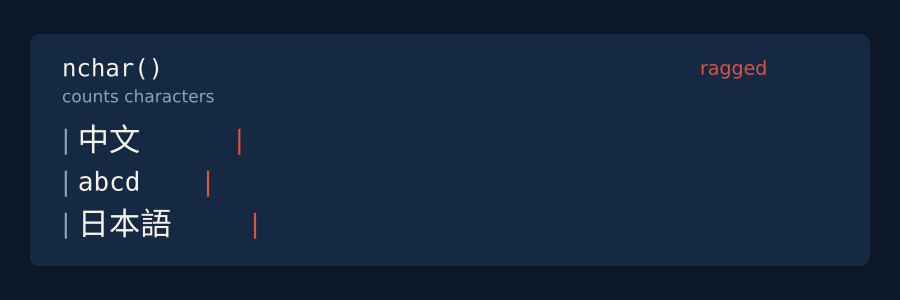
install.packages("tidycjk")library(tidycjk)cjk_width("中文") prints 4: two
characters, four terminal columns.| Task | Verbs |
|---|---|
| Detect | has_cjk() · cjk_script() ·
cjk_detect_language() · cjk_ratio() |
| Lay out | cjk_width() · cjk_pad() ·
cjk_truncate() · cjk_wrap() |
| Segment | cjk_segment() · cjk_tokens() ·
cjk_sentences() · cjk_ngrams() |
| Clean | to_halfwidth() · to_fullwidth() ·
cjk_normalize() · cjk_strip_punct() |
| Convert | cjk_romanize() · cjk_simplify() ·
cjk_traditionalize() · to_hiragana() ·
to_katakana() · cjk_jamo() ·
cjk_compose_jamo() |
| Summarise, sort | cjk_summary() · cjk_char_counts() ·
cjk_sort() · cjk_order() ·
cjk_blocks() |
Every verb is vectorised and keeps NA; the three that
take (data, column) return a tibble for a dplyr
pipeline.
cjk_detect_language(c("こんにちは", "안녕하세요", "東京都"))
#> [1] "japanese" "korean"   NA
cjk_segment("我今天很開心", engine = "icu")
#> [[1]]
#> [1] "我"   "今天" "很"   "開心"
cjk_pad(c("中文", "abcd"), 6)
#> [1] "中文  " "abcd  "
cjk_sort(c("張", "王", "李"), locale = "zh")
#> [1] "李" "王" "張"
cjk_summary(data.frame(text = c("我今天很開心", "hello 中文", "no CJK")), text)
#> # A tibble: 1 × 4
#>   n_docs n_with_cjk prop_with_cjk mean_ratio
#>    <int>      <int>         <dbl>      <dbl>
#> 1      3          2         0.667      0.417
東京都 is Tokyo: Japanese written only in Han
characters, which no script test can tell from Chinese, so the answer is
NA rather than a guess.
| Trap | What to do |
|---|---|
| Han-only text has no detectable language | pass han_only = "chinese" if you know the corpus |
engine has no default |
"icu" for words, "character" for
characters |
cjk_romanize() reads each Han character alone, as
Chinese |
treat it as a sort key; use gibasa for Japanese readings |
sort() on Han depends on LC_COLLATE |
cjk_sort(x, locale = "zh") |
| Plain NFC rewrites 460 of the 472 compatibility ideographs | keep the original column if the distinction matters |
| A file in GBK, Big5 or Shift_JIS | name it when reading:
read.csv(f, fileEncoding = "GBK") |
Four vignettes (tidycjk, segmentation,
width-and-layout, transliteration) and a visual
tour. For more than ICU gives: gibasa (MeCab, with
part of speech), udpipe (models for
all three languages), jiebaR (archived from CRAN,
install from GitHub) and OpenCC (regional
vocabulary).
These binaries (installable software) and packages are in development.
They may not be fully stable and should be used with caution. We make no claims about them.
Health stats visible at Monitor.