The hardware and bandwidth for this mirror is donated by dogado GmbH, the Webhosting and Full Service-Cloud Provider. Check out our Wordpress Tutorial.
If you wish to report a bug, or if you are interested in having us mirror your free-software or open-source project, please feel free to contact us at mirror[@]dogado.de.


tbl.now
extends tibble() for
storing, validating, and manipulating epidemiological nowcasting data.
It standardizes event dates, report dates, strata, temporal covariates,
and related metadata in a shape compatible with many frameworks,
including diseasenowcasting,
epinowcast, NobBS, surveillance,
EpiNow2, and more.
Finally, it also standardizes the prediction engines and their results
for plotting, scoring, comparing, and ensembling models.
A tbl_now keeps track of the attributes needed for a
nowcasting exercise, so dplyr transformations preserve the
relevant nowcasting variables:
| Argument | What it records | |
|---|---|---|
|
event_date
|
The column storing event dates; i.e. when the epidemiological phenomenon of interest happened (symptom onset, hospitalisation, death, …). Required. |
|
report_date
|
The column storing report dates; i.e. when that event
became known to the surveillance system. Required,
unless it is reconstructed from delay.
|

|
revision_date
|
An optional third date indicating when the report was resolved (see
revision_type). Optional.
|

|
revision_type, revision_levels
|
What the revision date resolved to. Only confirmed,
retracted, pending or NA are ever
stored; set revision_levels as a named dictionary mapping
the data’s labels into those four ( e.g. c(positive =
“confirmed”)). Optional.
|
|
now
|
The date the nowcast is anchored to — “today” from the model’s point of view. Optional; defaults to the latest date. |
|
strata
|
Columns you want a separate nowcast for (e.g. gender, region). Optional. |

|
covariates
|
Columns that inform the nowcast but that you do not want it broken down by (e.g. temperature or precipitation). Optional. |

|
case_count
|
The column holding the counts when the data is given as aggregated (rather than line-list). Optional. |
|
data_type
|
Whether the data represents a linelist (each row is a
case), count-incidence(each row is a collection of cases
per event-report date) or count-cumulative(each row is the
cummulative number cases for that event accumulating in the report
axis). Optional; inferred by default.
|

|
event_units, report_units,
revision_units
|
The time grid each date lives on: days, weeks,
months, years or numeric.
Optional; inferred (“auto”) by default.
|
|
is_censored_report,is_censored_revision
|
Flags dates from either the report or the revision axis that are only an upper bound, i.e. the true report happened before the date given in the database. Optional. |

|
t_effects
|
Columns holding temporal effects (day of week, holidays, …) that some models can use. Optional. |
You can specify an object as a tbl.now with the
tbl_now command:
library(dplyr)
library(tbl.now)
data(denguedat)

#Here we use just a few dates for the example
denguedat <- denguedat |>
  filter(onset_week >= as.Date("2005/01/01"),
         report_week <= as.Date("2005/10/01"))

#And we specify as a tbl_now:
denguedat <- denguedat |>
  tbl_now(
    report_date = report_week,
    event_date = onset_week,
    strata = gender
  )

#Which is just a tibble with extra attributes
denguedat
#> # A tibble:  1,652 × 6
#> # Data type: "linelist"
#> # Frequency: Event: `weeks` | Report: `weeks`
#>   onset_week   report_week   gender   .event_num .report_num .delay
#>   <date>       <date>        <chr>         <dbl>       <dbl>  <dbl>
#>   [event_date] [report_date] [strata]      [...]       [...]  [...]
#> 1 2005-01-03   2005-01-17    Male              0           2      2
#> 2 2005-01-03   2005-01-10    Female            0           1      1
#> 3 2005-01-03   2005-01-10    Female            0           1      1
#> 4 2005-01-03   2005-01-10    Male              0           1      1
#> 5 2005-01-03   2005-01-10    Male              0           1      1
#> # ────────────────────────────────────────────────────────────────────────────────────────────────────────────────────────────────────────────────────────────────
#> # Now: 2005-09-26 | Event date: "onset_week" | Report date: "report_week"
#> # Strata: "gender"
#> # ────────────────────────────────────────────────────────────────────────────────────────────────────────────────────────────────────────────────────────────────
#> # ℹ 1,647 more rows
Once transformed, it can help you diagnose data problems (see this article) or modeling requirements with your database:
autoplot(denguedat)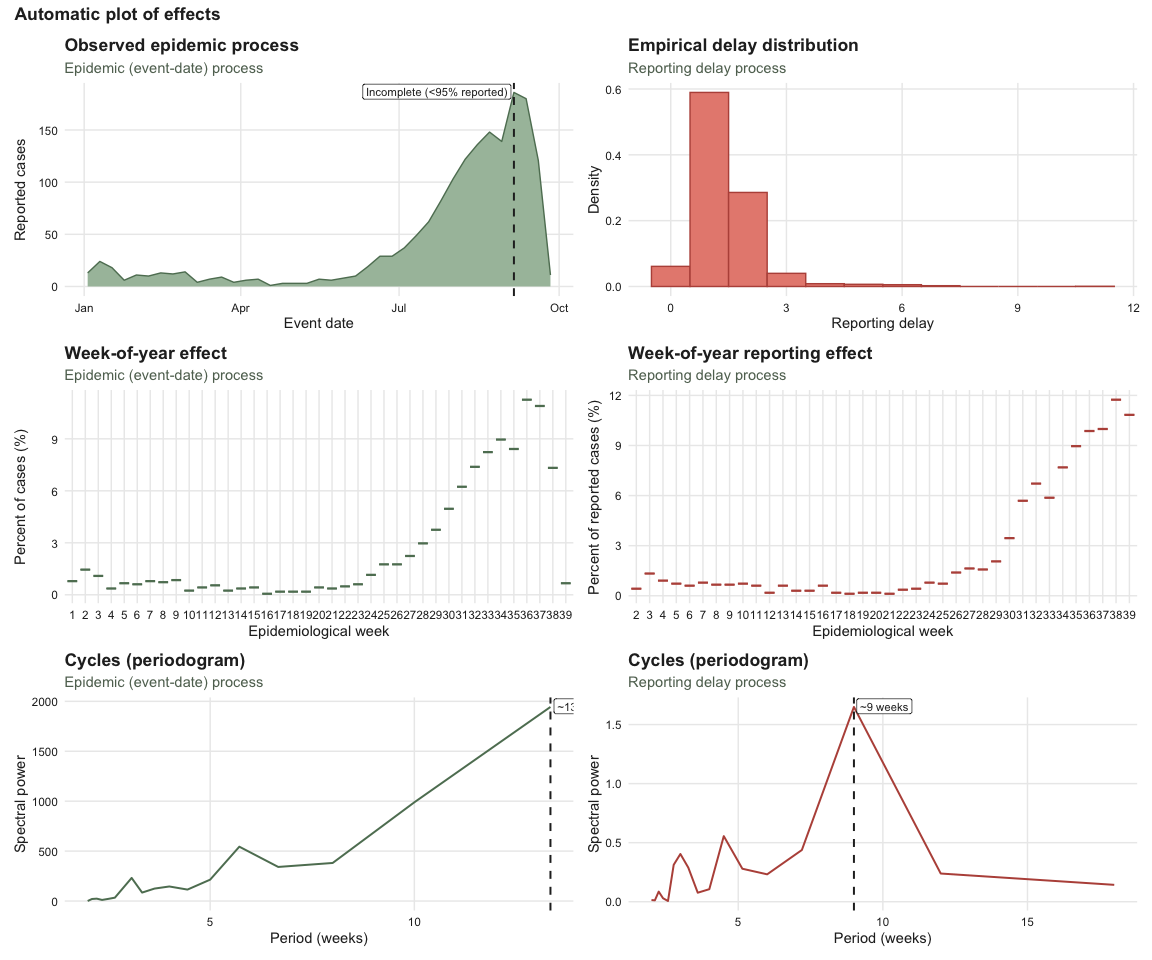
And it can be used to run any of multiple nowcast libraries through
the engine() and run_nowcast specifications
(see this
article). For example, baselinenowcast:
dengue_nowcast_1 <- denguedat |>
run_nowcast(engine = engine_baselinenowcast())autoplot(dengue_nowcast_1)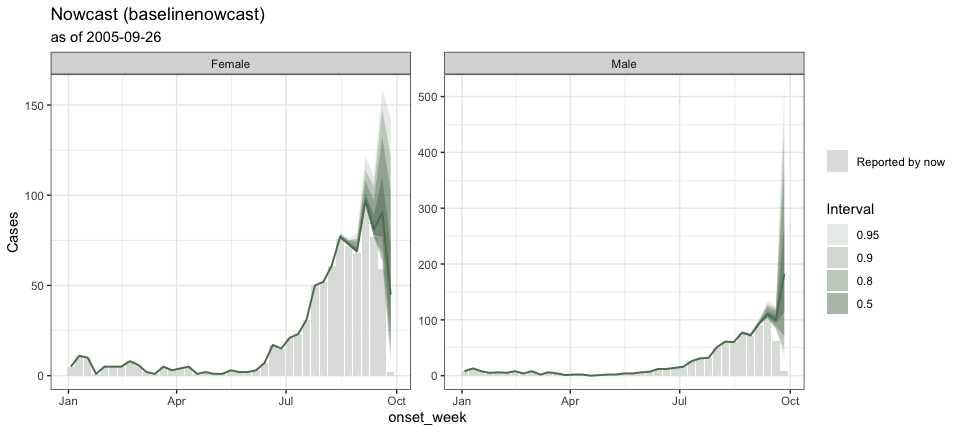
dengue_nowcast_2 <- denguedat |>
run_nowcast(engine = engine_diseasenowcasting())autoplot(dengue_nowcast_2)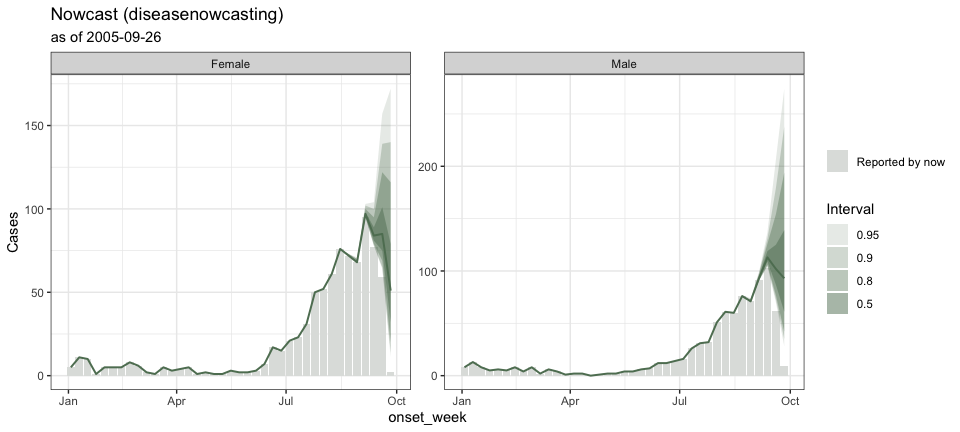
It can also generate ensemble nowcasts combining multiple engines or multiple realizations from the same engine as you can see in this article:
dengue_ensemble <- nowcast_ensemble(
  baselinenowcast   = dengue_nowcast_1,
  diseasenowcasting = dengue_nowcast_2
)autoplot(dengue_ensemble)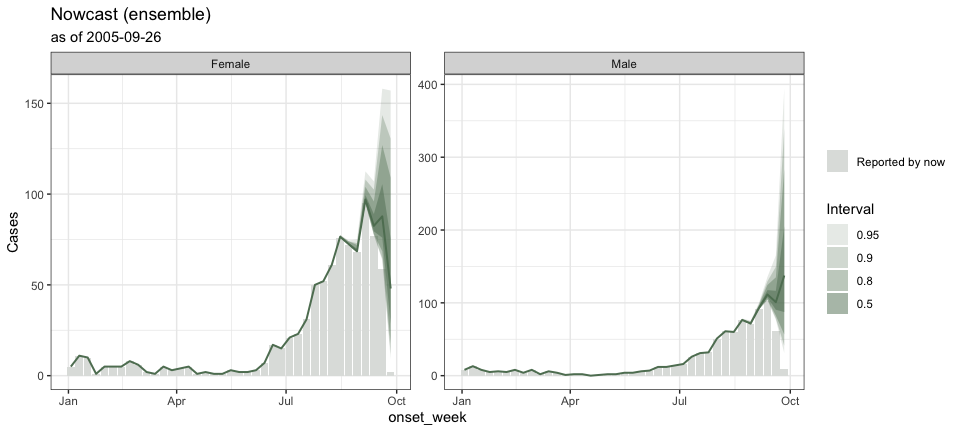
If this seems as exciting to you as it is to us, install the development version from R universe:
install.packages("tbl.now", repos = c("https://rodrigozepeda.r-universe.dev", getOption("repos")))and checkout our articles starting with the Get started guide:
If you have any questions or comments regarding the contents of this article please open an issue on Github.
tbl_now object: every
attribute, the three data types, the revision process, temporal effects
and the dplyr methods: https://rodrigozepeda.github.io/tbl.now/articles/more-on-tbl-now.htmltbl.now https://rodrigozepeda.github.io/tbl.now/articles/diagnosing-a-tbl-now.htmltbl.now https://rodrigozepeda.github.io/tbl.now/articles/batches.htmltbl.now:
here you can learn how it connects to the other nowcasting
packages. https://rodrigozepeda.github.io/tbl.now/articles/nowcasting-models.htmlThese binaries (installable software) and packages are in development.
They may not be fully stable and should be used with caution. We make no claims about them.
Health stats visible at Monitor.