htna:
Heterogeneous Transition Network Analysis
The hardware and bandwidth for this mirror is donated by dogado GmbH, the Webhosting and Full Service-Cloud Provider. Check out our Wordpress Tutorial.
If you wish to report a bug, or if you are interested in having us mirror your free-software or open-source project, please feel free to contact us at mirror[@]dogado.de.
htna:
Heterogeneous Transition Network Analysis


htna is an R package for Heterogeneous Transition
Network Analysis (HTNA) that models processes or interactions between a
mix two or more actor groups (e.g. Human and AI) as a single network.
HTNA builds on the traditions of Transition Network Analysis (TNA) and
Co-occurrence Network Analysis (CNA) and maintains the rigor of either
method.
The package provides a focused API on top of the Nestimate estimation engine and the cograph rendering engine: build a network over the combined sequence while preserving the actor partition, so downstream bootstrap, permutation, reliability, centrality, and plotting functions treat each actor’s codes as a distinct node group.
Install the released version of htna from CRAN:
install.packages("htna")Or the development version from GitHub:
# install.packages("devtools")
devtools::install_github("sonsoleslp/htna")library("htna")Load the example data shipped with htna:
data(human_ai)build_htna() takes a data frame with a column indicating
the actor type, combines the sequences, estimates transition
probabilities, and stores the actor partition on the resulting
network:
net <- build_htna(human_ai, actor_type = "actor_type")plot_htna() auto-detects the actor groups and renders
them with distinct colours:
plot_htna(net, threshold = 0.05, layout = "circular")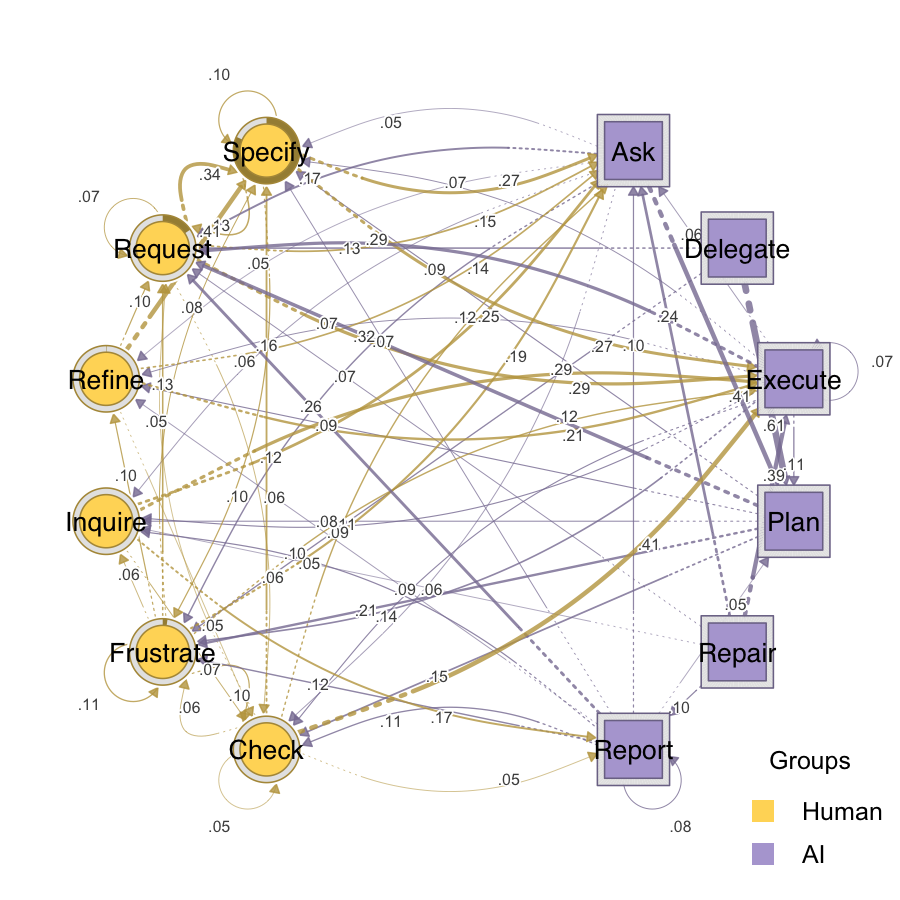
By default extract_meta_paths() enumerates concrete
state-level patterns and tags each row with the type-level template it
instantiates:
extract_meta_paths(net)
#> Patterns (state-level) over 429 sequences
#> Rows: 5445 | Lengths: 2, 3, 4 | Gaps: 0
#>              schema  meta_schema length gap count n_seq support frequency lift
#>    Request->Specify Human->Human      2   0  1042   402   0.937     0.055 2.27
#>           Ask->Plan       AI->AI      2   0   964   346   0.807     0.051 4.87
#>    Execute->Request    AI->Human      2   0   921   269   0.627     0.049 1.80
#>    Request->Execute    Human->AI      2   0   904   299   0.697     0.048 1.77
#>    Specify->Execute    Human->AI      2   0   796   261   0.608     0.042 1.66
#>        Specify->Ask    Human->AI      2   0   784   292   0.681     0.041 2.20
#>      Check->Execute    Human->AI      2   0   534   243   0.566     0.028 2.50
#>       Plan->Request    AI->Human      2   0   503   268   0.625     0.027 1.98
#>        Request->Ask    Human->AI      2   0   459   222   0.517     0.024 1.21
#>  Execute->Frustrate    AI->Human      2   0   451   230   0.536     0.024 1.50
#> ... (5435 more)
Filter to concrete instances of a type-level template. Schema parts
can mix type names, concrete codes, and *:
extract_meta_paths(net, schema = "Human->AI->Human")
#> State-level instances of schema 'Human->AI->Human' over 429 sequences
#> Rows: 163 | Lengths: 3 | Gaps: 0
#>                       schema      meta_schema length gap count n_seq support
#>    Request->Execute->Request Human->AI->Human      3   0   401   194   0.452
#>    Specify->Execute->Request Human->AI->Human      3   0   176   107   0.249
#>        Request->Ask->Request Human->AI->Human      3   0   130    91   0.212
#>      Check->Execute->Request Human->AI->Human      3   0   123    96   0.224
#>        Specify->Ask->Request Human->AI->Human      3   0   120    84   0.196
#>  Specify->Execute->Frustrate Human->AI->Human      3   0   114    88   0.205
#>  Request->Execute->Frustrate Human->AI->Human      3   0   106    88   0.205
#>    Request->Execute->Inquire Human->AI->Human      3   0    97    76   0.177
#>      Specify->Ask->Frustrate Human->AI->Human      3   0    86    70   0.163
#>    Inquire->Execute->Request Human->AI->Human      3   0    73    52   0.121
#>  frequency lift
#>      0.112 5.00
#>      0.049 2.33
#>      0.036 2.19
#>      0.034 3.67
#>      0.033 2.15
#>      0.032 2.57
#>      0.030 2.24
#>      0.027 4.40
#>      0.024 2.61
#>      0.020 3.31
#> ... (153 more)
extract_meta_paths(net, schema = "Human->Ask->*")
#> State-level instances of schema 'Human->Ask->*' over 429 sequences
#> Rows: 63 | Lengths: 3 | Gaps: 0
#>                   schema      meta_schema length gap count n_seq support
#>       Specify->Ask->Plan    Human->AI->AI      3   0   340   197   0.459
#>     Frustrate->Ask->Plan    Human->AI->AI      3   0   214   187   0.436
#>       Request->Ask->Plan    Human->AI->AI      3   0   139   106   0.247
#>    Request->Ask->Request Human->AI->Human      3   0   130    91   0.212
#>    Specify->Ask->Request Human->AI->Human      3   0   120    84   0.196
#>  Specify->Ask->Frustrate Human->AI->Human      3   0    86    70   0.163
#>       Inquire->Ask->Plan    Human->AI->AI      3   0    53    45   0.105
#>        Refine->Ask->Plan    Human->AI->AI      3   0    52    46   0.107
#>  Request->Ask->Frustrate Human->AI->Human      3   0    50    44   0.103
#>    Specify->Ask->Specify Human->AI->Human      3   0    49    41   0.096
#>  frequency  lift
#>      0.170 11.65
#>      0.107 11.71
#>      0.070  4.48
#>      0.065  2.19
#>      0.060  2.15
#>      0.043  2.61
#>      0.027  6.22
#>      0.026  6.57
#>      0.025  1.43
#>      0.025  0.93
#> ... (53 more)
Pass level = "type" for the type-level meta-path
summary:
extract_meta_paths(net, level = "type")
#> Meta-paths (type-level) over 429 sequences
#> Rows: 28 | Lengths: 2, 3, 4 | Gaps: 0
#>            schema length gap count n_seq support frequency lift
#>         Human->AI      2   0  5970   428   0.998     0.316 1.28
#>         AI->Human      2   0  5693   424   0.988     0.301 1.22
#>      Human->Human      2   0  4674   422   0.984     0.247 0.79
#>            AI->AI      2   0  2581   403   0.939     0.136 0.70
#>  Human->AI->Human      3   0  3593   402   0.937     0.194 1.41
#>  Human->Human->AI      3   0  3172   422   0.984     0.172 1.25
#>  AI->Human->Human      3   0  2828   403   0.939     0.153 1.11
#>     AI->Human->AI      3   0  2744   383   0.893     0.148 1.36
#>     Human->AI->AI      3   0  2189   403   0.939     0.118 1.09
#>     AI->AI->Human      3   0  2100   397   0.925     0.114 1.04
#> ... (18 more)tna –
Transition Network Analysis for homogeneous sequences.Nestimate
– Network estimation, bootstrap, permutation, reliability, and
centrality.cograph
– Network visualisation and rendering.codyna
– Sequence patterns, outcomes, and indices.These binaries (installable software) and packages are in development.
They may not be fully stable and should be used with caution. We make no claims about them.
Health stats visible at Monitor.