
The hardware and bandwidth for this mirror is donated by dogado GmbH, the Webhosting and Full Service-Cloud Provider. Check out our Wordpress Tutorial.
If you wish to report a bug, or if you are interested in having us mirror your free-software or open-source project, please feel free to contact us at mirror[@]dogado.de.



ggvariant reads variant data from a VCF file or a plain data frame
and produces ggplot2 plots for common tasks in variant
review: lollipop plots of variant position along a gene, consequence
summaries by sample or gene, mutational spectrum charts, and
cohort-level comparisons such as oncoprints and per-sample mutation
burden. Every function accepts either input format and returns a
standard ggplot object, so the result composes with any
ggplot2 layer, scale, or theme you already use. Designed
for both wet-lab biologists and experienced bioinformaticians.
Install the released version from CRAN:
install.packages("ggvariant")Install the development version from GitHub:
# install.packages("remotes")
remotes::install_github("josh45-source/ggvariant")Read a VCF file and plot variant positions along a gene:
library(ggvariant)

vcf_file <- system.file("extdata", "example.vcf", package = "ggvariant")
variants <- read_vcf(vcf_file)

plot_lollipop(variants, gene = "TP53")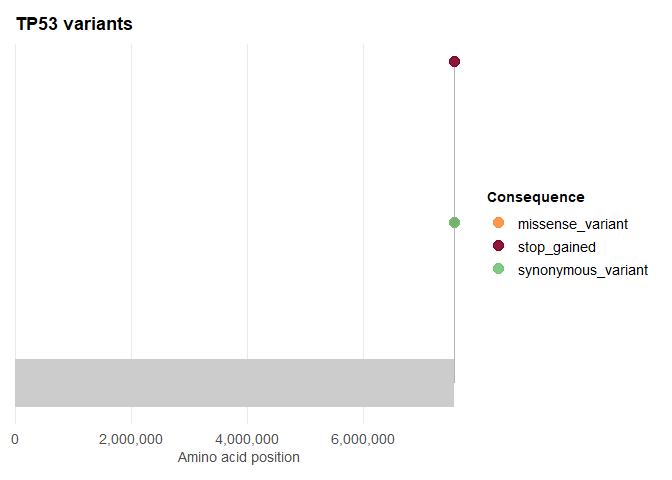
If your data is already in a data frame — a spreadsheet export, say,
rather than a VCF file — coerce_variants() maps your column
names onto the same tidy format instead.
read_vcf() parses VCF v4.x files, including gzipped and
multi-sample files, and extracts SnpEff (ANN) or VEP
(CSQ) annotations automatically.
coerce_variants() remaps an existing data frame’s columns
onto the same format.plot_lollipop(),
plot_consequence_summary(),
plot_variant_spectrum(), plot_oncoprint()
(also plot_waterfall(), an alias for the same function),
and plot_tmb().gv_palette() and
theme_ggvariant() expose the built-in colours and plot
theme for reuse in plots you build yourself.A few of the other plot types, on the same example data:
plot_consequence_summary(variants, group_by = "gene", top_n = 6)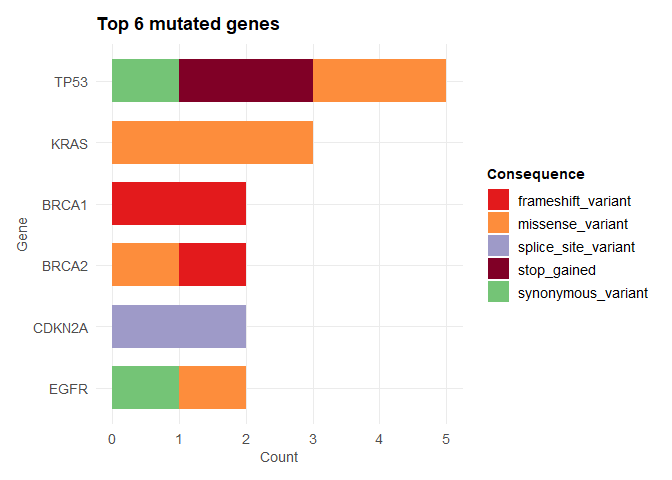
plot_variant_spectrum(variants)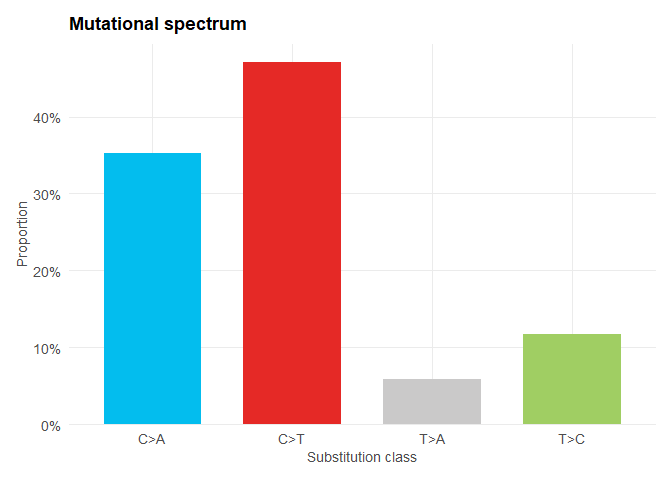
plot_oncoprint(variants, top_n = 6)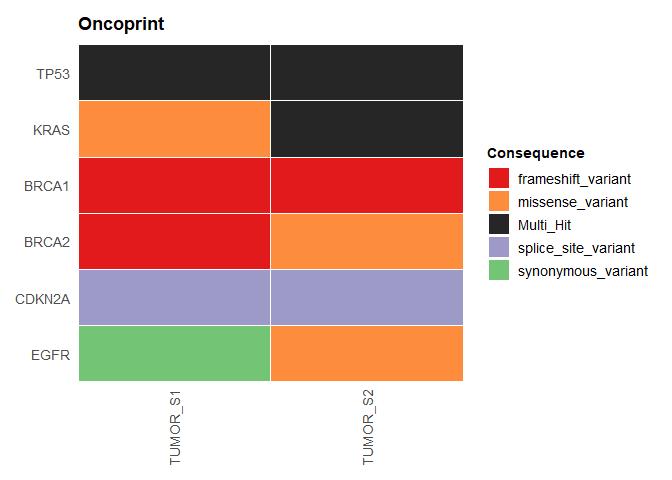
See vignette("ggvariant") for a full walkthrough —
domain annotations, colouring by sample, proportional and faceted views,
interactive plotly output — or the function
reference for argument details.
Every function returns a standard ggplot object, so any
ggplot2 layer, scale, or theme composes onto it
directly:
library(ggplot2)

plot_lollipop(variants, gene = "KRAS") +
  scale_colour_brewer(palette = "Set2") +
  theme(legend.position = "bottom") +
  labs(subtitle = "KRAS mutations in cohort X")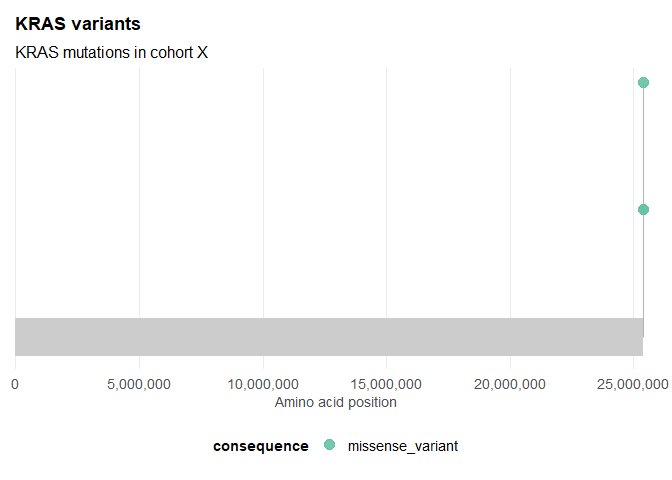
ggvariant/
├── R/
│   ├── ggvariant-package.R       # Package documentation
│   ├── read_vcf.R                # read_vcf() and coerce_variants()
│   ├── plot_lollipop.R           # plot_lollipop()
│   ├── plot_functions.R          # plot_consequence_summary(), plot_variant_spectrum()
│   └── utils.R                   # Theme, palettes, shared helpers
├── tests/
│   └── testthat/
│       └── test-core.R           # Unit tests
├── inst/
│   └── extdata/
│       └── example.vcf           # Bundled example VCF
├── DESCRIPTION
└── NAMESPACEPull requests are welcome. Please open an issue first to discuss proposed changes. All contributions should include tests.
The waterfall/oncoprint visualisation in v0.2.0 was suggested by Dr Nour-al-dain Marzouka.
MIT
If you use ggvariant in your research, please cite:
Ayo, J. J. (2026). ggvariant: Tidy, ggplot2-native visualization for genomic variants (R package version 0.1.0). CRAN. https://doi.org/10.32614/CRAN.package.ggvariant
These binaries (installable software) and packages are in development.
They may not be fully stable and should be used with caution. We make no claims about them.
Health stats visible at Monitor.