The hardware and bandwidth for this mirror is donated by dogado GmbH, the Webhosting and Full Service-Cloud Provider. Check out our Wordpress Tutorial.
If you wish to report a bug, or if you are interested in having us mirror your free-software or open-source project, please feel free to contact us at mirror[@]dogado.de.
The fastglm package is a fast and
stable alternative to stats::glm() for
fitting generalized linear models. It is built on RcppEigen and
is fully compatible with R’s family objects: the downstream
methods you expect (summary(), vcov(),
predict(), coef(), residuals(),
logLik()) all work exactly as they do for a
glm.
Beyond standard GLMs, fastglm provides dedicated fitting functions for negative-binomial regression, hurdle and zero-inflated count models, and Firth bias-reduced GLMs, all of which reuse the same C++ IRLS solver.
glm()
or glm2().Matrix::dgCMatrix), on-disc big.matrix
objects (bigmemory), and a streaming callback interface
(fastglm_streaming()) for fitting on data that does not fit
in memory.firth = TRUE) implementing the
AS_mean adjustment of Kosmidis and Firth (2009, 2021) for all standard
families, all six decomposition methods, and all three large-data
paths.fastglm_nb()) with joint
(beta, theta) MLE entirely in C++.fastglm_hurdle()) with Poisson or
NB count components and a binary zero/non-zero component.fastglm_zi()) with Poisson
or NB count distributions, fit by an EM algorithm in C++.vcov(), summary(),
predict(se.fit = TRUE), and compatibility with
sandwich::vcovHC() and sandwich::vcovCL() for
robust standard errors.Install from CRAN:
install.packages("fastglm")or the development version from GitHub:
pak::pak("jaredhuling/fastglm")The main function is fastglm(). It takes a numeric
design matrix x, a response y, and an R
family object:
library(fastglm)

data(esoph)
x <- model.matrix(~ agegp + unclass(tobgp) + unclass(alcgp), data = esoph)
y <- cbind(esoph$ncases, esoph$ncontrols)

fit <- fastglm(x, y, family = binomial(link = "cloglog"))
summary(fit)
#>
#> Call:
#> fastglm.default(x = x, y = y, family = binomial(link = "cloglog"))
#>
#> Coefficients:
#>                Estimate Std. Error z value Pr(>|z|)
#> (Intercept)    -4.29199    0.29777 -14.414  < 2e-16 ***
#> agegp.L         3.30677    0.63454   5.211 1.88e-07 ***
#> agegp.Q        -1.35525    0.57310  -2.365    0.018 *
#> agegp.C         0.20296    0.43333   0.468    0.640
#> agegp^4         0.15056    0.29318   0.514    0.608
#> agegp^5        -0.23425    0.17855  -1.312    0.190
#> unclass(tobgp)  0.33276    0.07285   4.568 4.93e-06 ***
#> unclass(alcgp)  0.80384    0.07538  10.664  < 2e-16 ***
#> ---
#> Signif. codes:  0 '***' 0.001 '**' 0.01 '*' 0.05 '.' 0.1 ' ' 1
#>
#> (Dispersion parameter for binomial family taken to be 1)
#>
#>     Null deviance: 61.609  on 87  degrees of freedom
#> Residual deviance: 96.950  on 80  degrees of freedom
#> AIC: 228
#>
#> Number of Fisher Scoring iterations: 6
fastglm() operates on a pre-built design matrix. To use
a formula and a data frame, pass fastglm_fit as the fitting
function to base glm():
fit2 <- glm(cbind(ncases, ncontrols) ~ agegp + unclass(tobgp) + unclass(alcgp),
            data = esoph, family = binomial(link = "cloglog"),
            method = fastglm_fit)
A third, minimal-use function, fastglmPure(), returns
only the coefficient vector and working quantities, skipping dispersion,
AIC, and null-deviance computation. Use this when calling
fastglm from another package and you only need the
coefficients.
The IRLS algorithm reduces every iteration to a weighted least-squares problem. fastglm supports six different matrix decompositions for solving that WLS step, all from RcppEigen (Bates and Eddelbuettel, 2013); the choice trades off speed against numerical stability and rank-revealing behavior:
method |
decomposition |
|---|---|
0 |
column-pivoted Householder QR (default; rank-revealing) |
1 |
unpivoted Householder QR |
2 |
LLT Cholesky |
3 |
LDLT Cholesky |
4 |
full-pivoted Householder QR |
5 |
bidiagonal divide-and-conquer SVD |
The default (method = 0) is the safe choice: it is
rank-revealing, so it handles aliased or collinear columns gracefully.
The Cholesky methods (2 and 3) are roughly
3–4x faster but assume full column rank.
set.seed(123)
n <- 5000; p <- 30
x <- matrix(rnorm(n * p), n, p)
y <- rbinom(n, 1, plogis(x %*% rnorm(p) * 0.05))

system.time(f0 <- fastglm(x, y, family = binomial()))                 # default QR
#>    user  system elapsed
#>   0.004   0.000   0.005
system.time(f2 <- fastglm(x, y, family = binomial(), method = 2))     # LLT
#>    user  system elapsed
#> 0.002 0.000 0.002fastglm runs the same IRLS algorithm as
glm.fit() but executes the per-iteration WLS solve in C++
via RcppEigen, which is often substantially faster than the
compiled-R + LAPACK path that glm.fit() uses. The gap
widens with sample size because the R-side overhead in
glm.fit() is fixed per iteration:
library(microbenchmark)
library(ggplot2)

set.seed(123)
n.obs  <- 10000
n.vars <- 100

x <- matrix(rnorm(n.obs * n.vars, sd = 3), n.obs, n.vars)
y <- 1 * (drop(x[, 1:25] %*% runif(25, -0.1, 0.1)) > rnorm(n.obs))

ct <- microbenchmark(
    glm.fit          = glm.fit(x, y, family = binomial()),
    fastglm_QR       = fastglm(x, y, family = binomial(), method = 0),
    fastglm_LLT      = fastglm(x, y, family = binomial(), method = 2),
    fastglm_LDLT     = fastglm(x, y, family = binomial(), method = 3),
    times = 25L
)

autoplot(ct, log = FALSE) +
    ggplot2::stat_summary(fun = median, geom = 'point', size = 2) +
    ggplot2::theme_bw()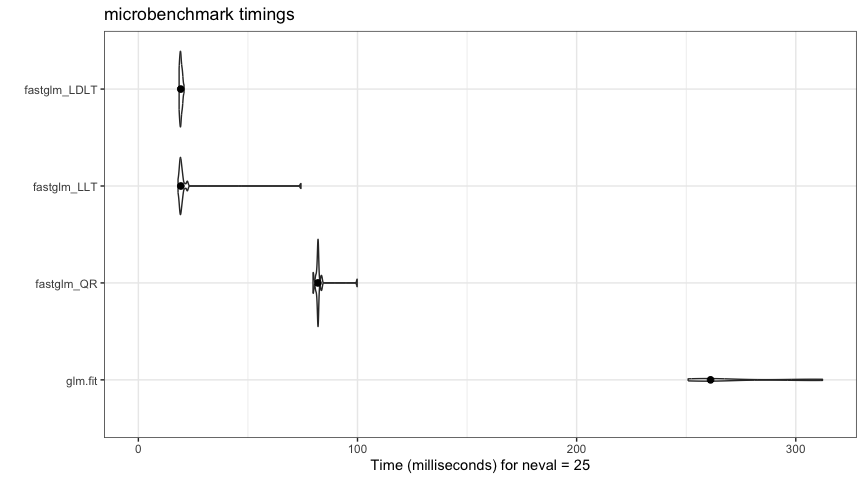
Coefficient estimates agree with glm.fit() to
floating-point precision:
gl <- glm.fit(x, y, family = binomial())
c(fastglm_QR   = max(abs(coef(gl) - coef(fastglm(x, y, family = binomial(), method = 0)))),
  fastglm_LLT  = max(abs(coef(gl) - coef(fastglm(x, y, family = binomial(), method = 2)))),
  fastglm_LDLT = max(abs(coef(gl) - coef(fastglm(x, y, family = binomial(), method = 3)))))
#>   fastglm_QR  fastglm_LLT fastglm_LDLT
#> 1.360023e-15 1.249001e-15 1.165734e-15fastglm does not compromise computational stability for
speed. It uses a step-halving safeguard following Marschner (2011) and
starts from better-initialized values than glm() or
glm2::glm2(), so it tends to converge in cases where the
standard IRLS algorithm fails. As an example, consider a Gamma model
with a sqrt link — a mild response misspecification
combined with a badly misspecified link. In such scenarios the standard
IRLS algorithm tends to have convergence issues:
set.seed(1)
x <- matrix(rnorm(10000 * 100), ncol = 100)
y <- (exp(0.25 * x[,1] - 0.25 * x[,3] + 0.5 * x[,4] - 0.5 * x[,5] + rnorm(10000))) + 0.1

gfit1 <- glm(y ~ x, family = Gamma(link = "sqrt"), method = fastglm_fit)
gfit2 <- glm(y ~ x, family = Gamma(link = "sqrt"))

## fastglm converges with a higher likelihood
c(fastglm_converged = gfit1$converged, glm_converged = gfit2$converged)
#> fastglm_converged     glm_converged
#>              TRUE             FALSE
c(fastglm_logLik = logLik(gfit1), glm_logLik = logLik(gfit2))
#> fastglm_logLik     glm_logLik
#>      -16046.66      -16704.05
See vignette("fastglm", package = "fastglm") for the
full comparison, including glm2::glm2() and
speedglm.
For the most commonly used family/link
combinations, fastglm dispatches variance(),
mu.eta(), linkinv(), and
dev.resids() to inline C++ implementations rather than
calling back into R once per IRLS iteration. The covered combinations
are:
Detection is automatic: if the family object matches one
of the above, the native path is used; otherwise fastglm falls
back to the R-callback path. The C++ native approach is meaningfully
faster on large n because it eliminates the per-iteration
calls to R for each of the four family functions.
For designs that are sparse, that live on disc, or that have to be built from a parquet / arrow / DuckDB source, fastglm provides three large-data paths that share a common streaming kernel and produce identical results:
Matrix::dgCMatrix: pass directly to
fastglm(). Useful for one-hot encoded categoricals and
high-dimensional sparse designs.bigmemory::big.matrix: pass directly
to fastglm(). The matrix is read in row-blocks and never
fully materialized in memory.fastglm_streaming(chunk_callback, n_chunks, family):
a user-supplied closure yields one row-block per call. The right path
for fitting on a parquet dataset, DuckDB query, or any external
columnar store.A short example of the streaming computation approach:
n <- 4000
X <- cbind(1, matrix(rnorm(n * 3), n, 3))
y <- rbinom(n, 1, plogis(X %*% c(0.2, 0.4, -0.2, 0.3)))

chunk_size <- 1000
chunks <- function(k) {
    idx <- ((k - 1) * chunk_size + 1):(k * chunk_size)
    list(X = X[idx, , drop = FALSE], y = y[idx])
}

fit_stream <- fastglm_streaming(chunks, n_chunks = 4, family = binomial())
fit_full   <- fastglm(X, y, family = binomial(), method = 2)

max(abs(coef(fit_stream) - coef(fit_full)))
#> [1] 1.042751e-07
See vignette("large-data-fastglm", package = "fastglm")
for a detailed walk-through of all three paths.
fastglm_nb() fits negative-binomial regression with the
dispersion theta estimated jointly with the regression
coefficients, in the spirit of MASS::glm.nb(). The joint
(beta, theta) MLE runs entirely in C++; IRLS for
beta, Brent’s method for theta:
set.seed(123)
n <- 5000
X <- cbind(1, matrix(rnorm(n * 3), n, 3))
mu <- exp(X %*% c(0.5, 0.4, -0.2, 0.3))
y <- MASS::rnegbin(n, mu = mu, theta = 2)

f_nb <- fastglm_nb(X, y)
c(coef = coef(f_nb), theta = f_nb$theta)
#>    coef.x1    coef.x2    coef.x3    coef.x4      theta
#> 0.4926199 0.3862258 -0.2200450 0.2991296 1.9923309fastglm_hurdle() fits a two-part count model: a binary
regression for whether y > 0, plus a zero-truncated
Poisson or NB regression on the positive subset. The two parts factorize
and both are fit by the same C++ IRLS solver. This is the same model as
pscl::hurdle() (Zeileis, Kleiber, and Jackman, 2008).
Different designs for the count and zero parts are specified via the
Formula package’s two-RHS syntax:
set.seed(123)
n <- 5000
x1 <- rnorm(n);  x2 <- rnorm(n)
lam <- exp(0.7 + 0.4 * x1 - 0.3 * x2)
is_pos <- rbinom(n, 1, plogis(-0.4 + 0.5 * x1 + 0.2 * x2))
yt <- integer(n)
for (i in seq_len(n)) {
    repeat { v <- rpois(1, lam[i]); if (v > 0) { yt[i] <- v; break } }
}
y <- ifelse(is_pos == 1, yt, 0L)

f_h <- fastglm_hurdle(y ~ x1 + x2, data = data.frame(y, x1, x2), dist = "poisson")
coef(f_h)
#> count_(Intercept)          count_x1          count_x2  zero_(Intercept)
#>         0.6793788         0.4162547        -0.3137229        -0.3767285
#>           zero_x1           zero_x2
#> 0.4447325 0.1999711fastglm_zi() fits a zero-inflated Poisson or NB
regression, a binary inflation component overlaid on the original count
distribution, fit by an EM algorithm in C++ with closed-form posterior
responsibilities and an analytical observed-information
vcov. This is the same model as
pscl::zeroinfl():
set.seed(123)
n <- 5000
x1 <- rnorm(n);  x2 <- rnorm(n)
eta_c <- 0.7 + 0.4 * x1 - 0.3 * x2
eta_z <- -0.4 + 0.5 * x1 + 0.2 * x2
z <- rbinom(n, 1, plogis(eta_z))
y <- ifelse(z == 1, 0L, rpois(n, exp(eta_c)))

f_zi <- fastglm_zi(y ~ x1 + x2, data = data.frame(y, x1, x2), dist = "poisson")
coef(f_zi)
#> count_(Intercept)          count_x1          count_x2  zero_(Intercept)
#>         0.6647396         0.3965153        -0.3407168        -0.3750258
#>           zero_x1           zero_x2
#> 0.4512788 0.1819040Setting firth = TRUE activates the general mean-bias
reduction of Kosmidis and Firth (2009, 2021). This extends Firth’s
(1993) original logistic penalty to arbitrary GLM families, producing
finite estimates even under separation and removing the leading \(O(1/n)\) bias from maximum likelihood
estimates:
data(sex2, package = "logistf")
X <- model.matrix(~ age + oc + vic + vicl + vis + dia, data = sex2)
y <- sex2$case

f_firth <- fastglm(X, y, family = binomial(), firth = TRUE)
coef(f_firth)
#> (Intercept)         age          oc         vic        vicl         vis
#>  0.12025405 -1.10598133 -0.06881673  2.26887465 -2.11140819 -0.78831695
#>         dia
#>  3.09601183
Firth bias reduction works with all six decomposition methods, all
standard R families and link functions, and all three large-data paths
(sparse, big.matrix, streaming). See
vignette("firth-fastglm", package = "fastglm") for
verification against logistf::logistf() and
brglm2::brglmFit().
The fitted object stores the unscaled covariance directly, so
vcov() and summary() work as expected.
Heteroskedasticity-consistent and cluster-robust covariance matrices are
available via sandwich::vcovHC() and
sandwich::vcovCL(), fastglm registers methods on
those generics, so loading sandwich is all that is
required:
library(sandwich)
V_hc <- vcovHC(fit, type = "HC0")
V_cl <- vcovCL(fit, cluster = cluster, type = "HC1")
Results are numerically identical to sandwich applied to
a glm fit to floating-point precision.
predict() supports se.fit = TRUE:
predict(fit, newdata = xnew, type = "response", se.fit = TRUE)A comprehensive benchmarking study is available in
vignette("benchmarks-fastglm", package = "fastglm"),
comparing fastglm against the canonical reference
implementations across standard GLMs (glm.fit,
glm2, speedglm), negative-binomial regression
(MASS::glm.nb), Firth bias-reduced GLMs
(brglm2, logistf), and hurdle / zero-inflated
count regressions (pscl::hurdle,
pscl::zeroinfl).
The following summary plot shows the speedup fastglm
delivers over the canonical reference for each model class, as a
function of sample size. The reference for the standard GLMs is the
fastest among glm.fit, glm2, and
speedglm, so the comparison is conservative. Larger is
better:
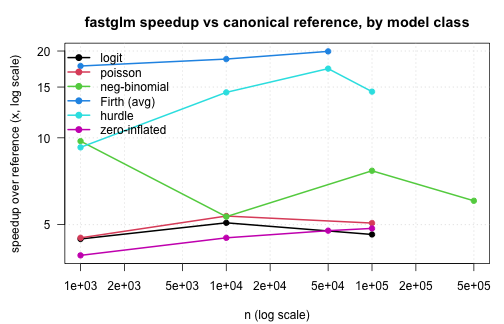
Across all model classes the same picture holds: fastglm matches the canonical reference implementation to floating-point precision, and the runtime gap grows with sample size. By \(n = 10^5\) the speedup is generally an order of magnitude or more. For models with an outer iteration (NB joint MLE, hurdle/ZI with NB), the gap is widest, since the entire outer loop is in C++ in fastglm and entirely in R in the reference implementations.
Firth, D. (1993). Bias reduction of maximum likelihood estimates. Biometrika, 80(1), 27–38.
Kosmidis, I. and Firth, D. (2009). Bias reduction in exponential family nonlinear models. Biometrika, 96(4), 793–804.
Kosmidis, I. and Firth, D. (2021). Jeffreys-prior penalty, finiteness and shrinkage in binomial-response generalized linear models. Biometrika, 108(1), 71–82.
Marschner, I. C. (2011). glm2: Fitting generalized linear models with convergence problems. The R Journal, 3(2), 12–15.
Bates, D. and Eddelbuettel, D. (2013). Fast and elegant numerical linear algebra using the RcppEigen package. Journal of Statistical Software, 52(5), 1–24.
Zeileis, A., Kleiber, C., and Jackman, S. (2008). Regression models for count data in R. Journal of Statistical Software, 27(8), 1–25.
These binaries (installable software) and packages are in development.
They may not be fully stable and should be used with caution. We make no claims about them.
Health stats visible at Monitor.