The hardware and bandwidth for this mirror is donated by dogado GmbH, the Webhosting and Full Service-Cloud Provider. Check out our Wordpress Tutorial.
If you wish to report a bug, or if you are interested in having us mirror your free-software or open-source project, please feel free to contact us at mirror[@]dogado.de.
Document intelligence for R — turn messy PDFs, Office files and HTML into AI-ready, structured data.






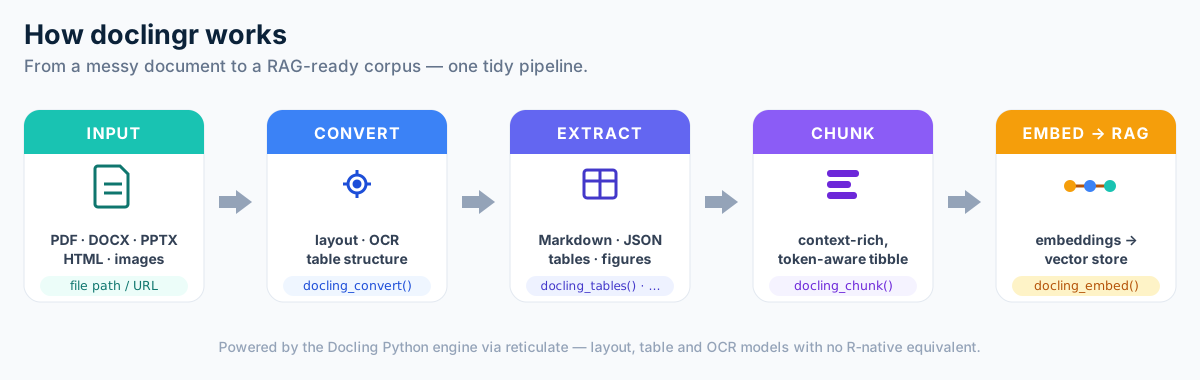
doclingr is an R interface to Docling, an open-source document-understanding library. It brings layout-aware PDF/DOCX/PPTX/HTML parsing, table extraction, OCR and RAG-ready chunking to R, exposing it through a small, tidy-friendly API built on reticulate.
R already has pdftools, tabulizer,
officer, readtext and friends, but no single
“document intelligence for RAG” package. doclingr aims to fill that gap:
take a document, understand its layout, extract its tables, preserve its
structure, chunk it, and hand it back ready for search and
embeddings.
 Installation
# install.packages("pak")
pak::pak("StrategicProjects/doclingr")
doclingr talks to the Docling Python package via reticulate. Install the backend once:
library(doclingr)
install_docling()      # creates an "r-docling" Python environment
# restart R
docling_available() # TRUElibrary(doclingr)
doc <- docling_convert("https://arxiv.org/pdf/2408.09869")
# Export
as_markdown(doc) # layout-aware Markdown
as_json(doc) # structured DoclingDocument as an R list
# Pages and tables
docling_n_pages(doc)
tables <- docling_tables(doc) # list of tibbles
tables[[1]]
# Figures -> tibble (captions, pages, optional saved images)
doc <- docling_convert("paper.pdf", images = TRUE)
docling_figures(doc, image_dir = "figures")
# RAG-ready chunks -> tibble
chunks <- docling_chunk(doc, max_tokens = 512)
chunks$text[1]
# Match your embedding model's tokenizer for accurate budgets
chunks <- docling_chunk(doc, tokenizer = "BAAI/bge-small-en-v1.5", max_tokens = 512)doclingr stays provider-agnostic: bring any embedding function (an
API call, a local model via reticulate, …) and
docling_embed() handles batching and tidy assembly into an
embedding list-column.
embed_openai <- function(txt) {
  # your call to an embeddings API -> matrix (one row per text)
}

doc |>
  docling_chunk(max_tokens = 512) |>
  docling_embed(embed_openai, batch_size = 64)
#> # adds `embedding` (list-column) and `n_dim` columnsDocling’s quality comes from deep-learning models (layout analysis,
the TableFormer table-structure model, OCR). Those have no R-native
equivalent, so doclingr binds the maintained Python implementation
rather than reimplementing it — the same strategy used by
tensorflow, keras and spacyr. You
get upstream parity for free; doclingr focuses on an idiomatic, tidy R
surface.
Actively developed and heading to CRAN. The public API is settling but may still change before 1.0. Contributions and issues are welcome at https://github.com/StrategicProjects/doclingr.
MIT © doclingr authors
These binaries (installable software) and packages are in development.
They may not be fully stable and should be used with caution. We make no claims about them.
Health stats visible at Monitor.