
The hardware and bandwidth for this mirror is donated by dogado GmbH, the Webhosting and Full Service-Cloud Provider. Check out our Wordpress Tutorial.
If you wish to report a bug, or if you are interested in having us mirror your free-software or open-source project, please feel free to contact us at mirror[@]dogado.de.
Easy and efficient rendering of very large geospatial data in the browser.
deckglgeoarrow provides functionality to efficiently
visualise potentially very large geospatial data as Deck.gl layers on top of a maplibre/mapbox map created with
package mapgl.
For very quick and efficient data transfer from R memory to the
browser, geoarrowWidget
is used. Layer creation is done in ‘JavaScript’ using geoarrow/deck.gl-geoarrow
(see Features
section for details on how and why layer creation is efficient).
Currently, (MULTI)POINT, (MULTI)LINESTRING
and (MULTI)POLYGON features are supported by the following
layer functions:
addGeoarrowScatterplotLayer
for point dataaddGeoarrowPathLayer
for linestring dataaddGeoarrowPolygonLayer
for polygon dataSupport for other layers, such as discrete global grid
layers (S2, A5, H3),
origin-destination layers (Arc,
trips) and point-cloud layers, among others,
will follow.
Spatial classes from the following R packages are supported (via
data argument):
The following local or remotely hosted files types are supported (via
file/url argument):
Note, that due to a restriction
in the upstream JavaScript dependency, only files with native
GeoArrow geometry encoding are supported. WKB
encoded geometries will not render!
In addition, nanoarrow
array_streams (as files) are supported.
The development version of deckglgeoarrow can be installed from GitHub with:
# install.packages("pak")
pak::pak("r-spatial/deckglgeoarrow")To showcase what the package can do, consider this example.
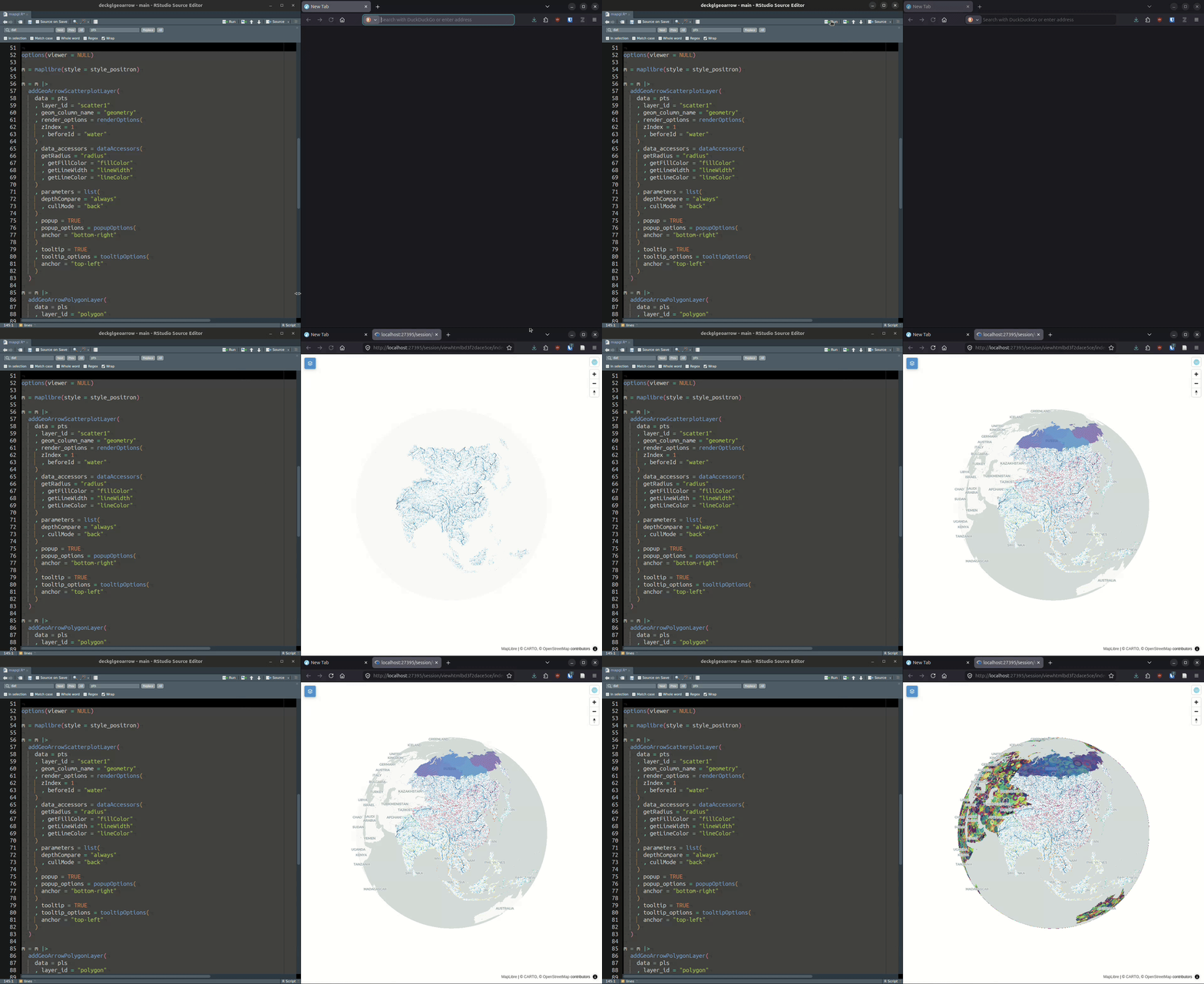
Here, we visualise
in one map.
Here’s how quickly this renders:
More examples can be found here
This project has been realized with financial support from the

These binaries (installable software) and packages are in development.
They may not be fully stable and should be used with caution. We make no claims about them.
Health stats visible at Monitor.