The hardware and bandwidth for this mirror is donated by dogado GmbH, the Webhosting and Full Service-Cloud Provider. Check out our Wordpress Tutorial.
If you wish to report a bug, or if you are interested in having us mirror your free-software or open-source project, please feel free to contact us at mirror[@]dogado.de.




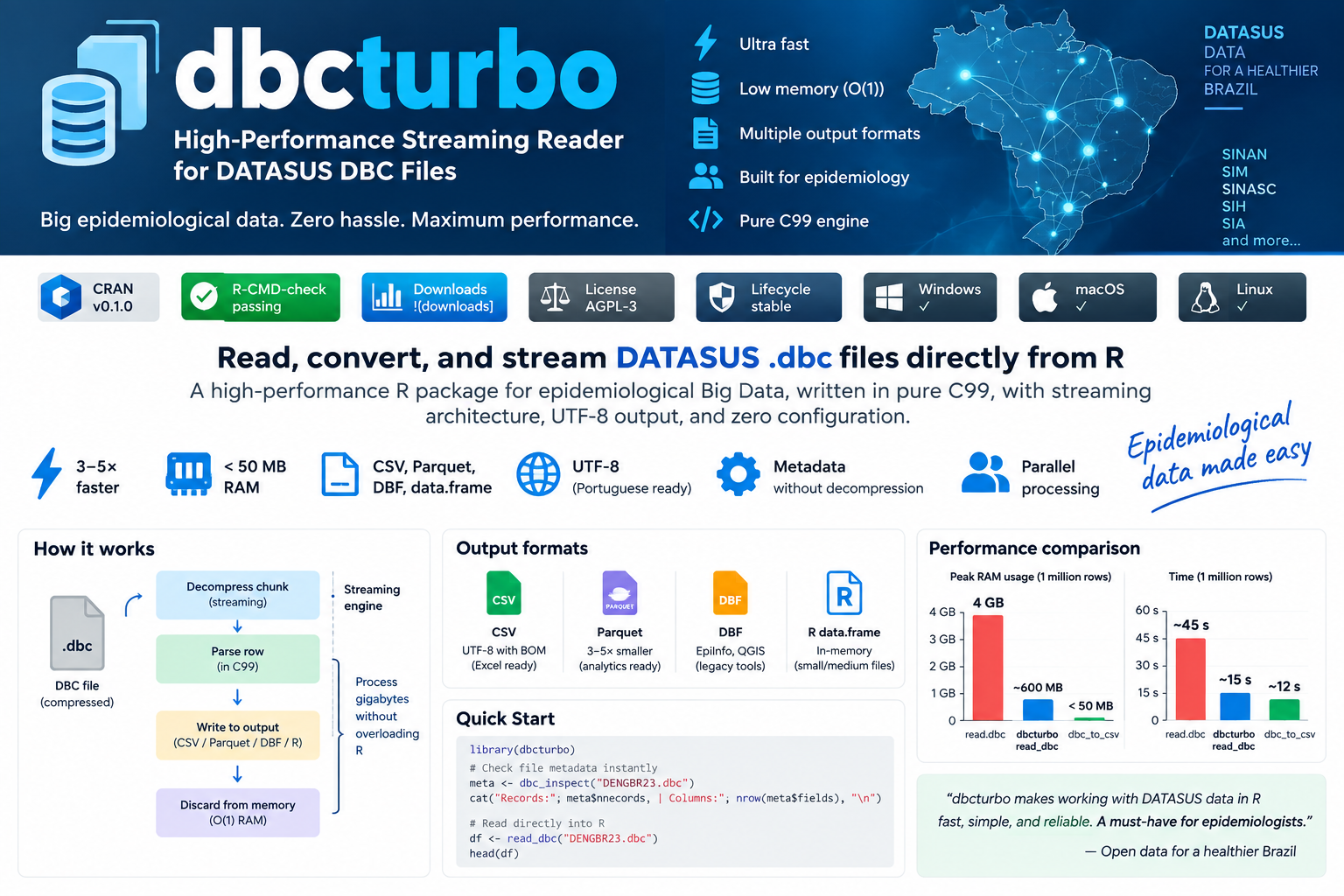
dbcturbo is an R package to inspect, read, and
convert DATASUS .dbc files, with direct streaming CSV/DBF
conversion and UTF-8 CSV output.
The C99 engine writes CSV rows directly from the decompression stream
with bounded memory. read_dbc() uses a direct native reader
for files up to 50 MiB by default and a CSV reader for larger files; it
intentionally materializes its final data frame in memory.
dbc_to_parquet() uses a temporary CSV before conversion
with Arrow.
ã,
ç, é) render perfectly in Excel.arrow.| Feature | dbcturbo |
read.dbc |
|---|---|---|
| Streaming conversion in batches | ✅ | ❌ |
| Clean UTF-8 output with BOM | ✅ | ❌ |
| Parquet conversion via Arrow | ✅ | ❌ |
| Direct CSV export | ✅ | ❌ |
| Inspect metadata without decompressing | ✅ | ❌ |
| Directory batch conversion | ✅ | ❌ |
| Thread-safe C99 engine | ✅ | ❌ |
| Bounded-memory CSV/DBF conversion | ✅ | ❌ |
Unlike traditional readers that load the entire compressed and
uncompressed DBF payload into RAM simultaneously, dbcturbo
processes records iteratively:
       ┌──────────────┐
       │   .dbc File  │  Compressed DATASUS database
       └──────┬───────┘
              │
              ▼
   ┌──────────────────────┐
   │ blast() Decompressor │  64 KB chunk decompression
   └──────────┬───────────┘
              │
              ▼
   ┌──────────────────────┐
   │  C99 Parsing Engine  │  Parse row + transcode encoding to UTF-8
   └──────────┬───────────┘
              │
              ▼
   ┌──────────────────────┐
   │ Stream Write to Disk │  Write batch to CSV / DBF
   └──────────┬───────────┘
              │
              ▼
   ┌──────────────────────┐
   │   Discard from RAM   │  Bounded memory for CSV / DBF conversion
└──────────────────────┘Performance depends on the file, encoding, storage device, batch
size, and hardware. On a local Ubuntu test, converting
DENGBR23.dbc (1,645,956 rows, 121 fields) to CSV completed
in 7.78 seconds. Re-run benchmarks on the target machine before relying
on a throughput estimate.
library(dbcturbo)

# Check file metadata instantly (no decompression needed)
meta <- dbc_inspect("DENGBR23.dbc")
cat("Records:", meta$nrecords, "| Columns:", nrow(meta$fields), "\n")
#> Records: 1,645,956 | Columns: 121

# Small files use the native C reader automatically (up to 50 MiB)
df <- read_dbc("small_file.dbc")
head(df)
For large files, install the optional data.table
package. read_dbc() will use it automatically above the
native threshold, or request it explicitly with
engine = "data.table"; use engine = "native"
to force direct native decoding and engine = "base" to
force R’s built-in reader.
install.packages("data.table")
df <- read_dbc("DENGBR23.dbc", engine = "data.table")# From CRAN (stable)
install.packages("dbcturbo")
# From GitHub (development)
remotes::install_github("GPimentel14/dbcturbo")Requirements: A standard C compiler is needed to build from source — Rtools on Windows, or GCC/Clang on Linux/macOS. CRAN binaries require no compiler.
Choose the format that best fits your workflow:
library(dbcturbo)
df <- read_dbc("DENGBR23.dbc")
head(df)Outputs a clean UTF-8 CSV with BOM — Portuguese characters (ã, ç, é) display correctly in Excel without configuration.
library(dbcturbo)
# Select fields in the C writer to reduce output size and downstream work
dbc_to_csv(
  "DENGBR23.dbc", "dengue_2023.csv",
  cols = c("DT_NOTIFIC", "SG_UF_NOT", "NU_IDADE_N"),
  verbose = TRUE
)Parquet is columnar and convenient to query with R
(arrow), Python (pandas, polars),
Power BI, and DuckDB. The conversion first creates a temporary CSV, so
ensure enough temporary disk space is available.
library(dbcturbo)
dbc_to_parquet("DENGBR23.dbc", "dengue_2023.parquet")
⚠️ Always use
.parquetas the output extension. Passing a.csvpath todbc_to_parquet()will raise an informative error.
For EpiInfo, QGIS, and other tools that read dBase format.
library(dbcturbo)
dbc2dbf("DENGBR23.dbc", "dengue_2023.dbf")library(dbcturbo)
meta <- dbc_inspect("DENGBR23.dbc")
print(meta$nrecords) # total records
print(meta$fields) # field names, types, widths, decimalsMicrosoft Excel supports a maximum of 1,048,576
rows.
Many national DATASUS files (e.g., Dengue, SINASC) exceed this
limit.
Solution — filter in R before exporting:
library(dbcturbo)

df <- read_dbc("DENGBR23.dbc")

# Filter to one state (two-digit IBGE code)
df_rs <- df[df$SG_UF_NOT == "43", ]   # Rio Grande do Sul
df_sp <- df[df$SG_UF_NOT == "35", ]   # São Paulo

# Now it fits in Excel
write.csv(df_rs, "dengue_2023_RS.csv", row.names = FALSE)
Common state codes: "35" SP · "33" RJ ·
"43" RS · "41" PR · "29" BA ·
"13" AM
NU_IDADE_N)decode_age <- function(x) {
x <- as.integer(x)
unit <- x %/% 1000
value <- x %% 1000
ifelse(unit == 4, value,
ifelse(unit == 3, value / 12,
ifelse(unit == 2, value / 365,
ifelse(unit == 1, value / 8760, NA_real_))))
}
df$age_years <- decode_age(df$NU_IDADE_N)# read_dbc() already returns DBF date fields as Date by default
df$delay_days <- as.numeric(df$DT_NOTIFIC - df$DT_SIN_PRI)result <- dbc_batch_to_csv(
input_dir = "dbc/2023/",
output_dir = "csv/2023/",
recursive = TRUE,
workers = 4L # macOS/Linux; use 1L on Windows
)parallel::mclapply() uses multiple processes on macOS
and Linux. On Windows, use dbc_batch_to_csv() sequentially
or a Windows-compatible parallel backend.
library(parallel)
files <- list.files("datasus/", pattern = "\\.dbc$", full.names = TRUE)
mclapply(files, function(f) {
  dbc_to_csv(f, sub("\\.dbc$", ".csv", f))
}, mc.cores = 4L)library(duckdb)
con <- dbConnect(duckdb())
dbGetQuery(con, "
SELECT SG_UF_NOT, COUNT(*) AS cases
FROM 'dengue_2023.parquet'
GROUP BY SG_UF_NOT ORDER BY cases DESC
")
dbDisconnect(con)vignette("introduction", package = "dbcturbo")?dbc_to_csv,
?dbc_to_parquet, ?read_dbc,
?dbc_inspectIf you use dbcturbo in your research or institutional
pipelines, please cite it:
@Manual{,
  title  = {dbcturbo: High-Performance Streaming Reader for DATASUS DBC Files},
  author = {Gumercindo {Pimentel Peralta} and Juliana {da Silva}},
  year   = {2026},
  note   = {R package version 0.2.0},
  url    = {https://github.com/GPimentel14/dbcturbo},
}
These binaries (installable software) and packages are in development.
They may not be fully stable and should be used with caution. We make no claims about them.
Health stats visible at Monitor.