The hardware and bandwidth for this mirror is donated by dogado GmbH, the Webhosting and Full Service-Cloud Provider. Check out our Wordpress Tutorial.
If you wish to report a bug, or if you are interested in having us mirror your free-software or open-source project, please feel free to contact us at mirror[@]dogado.de.
Debiased (Neyman-orthogonalized) score tests for assessing whether a semiparametric or parametric regression model is well-specified and for comparing nested models.
The test uses a hunt-and-test strategy with sample splitting: on a
held-out hunt sample, it fits the null model and uses machine
learning to find a direction in which the null model’s score seems
positive; on an independent test sample, it assesses the
significance of the score in the hunted direction. The test employs
orthogonalization to eliminate the plug-in bias from estimating the null
model, yielding a test statistic that is asymptotically standard normal
under the null without requiring a parametric form for the alternative.
Methods are provided for glm, lm, and
mgcv::gam fits as well as for detecting heterogeneous
treatment effects.
You can install the package from CRAN with
install.packages("dScoreTest")or the development version from GitHub with
# install.packages("remotes")
remotes::install_github("richardkwo/dScoreTest")Two entry points, both S3 generics that dispatch on the fitted model:
gof_test() — is a fitted model well-specified, against
a nonparametric alternative?compare_models() — does a nested alternative capture
signal that the null model misses?library(dScoreTest)
library(mgcv)
set.seed(42)
dat <- gamSim(eg = 1, n = 400, dist = "normal", scale = 2, verbose = FALSE)We simulate from the four-term additive truth in
mgcv::gamSim(eg = 1),
y = f0(x0) + f1(x1) + f2(x2) + f3(x3) + noise, where
f3 = 0 and f0, f1, f2 are non-linear.
gof_test() checks the functional form of a fitted model
against a nonparametric alternative. A well-specified non-linear
additive model is not rejected, while forcing the model to be linear
is.
fit.gam <- gam(y ~ s(x0) + s(x1) + s(x2) + s(x3), data = dat)
gof_test(fit.gam)   # well-specified: not rejected
#> Debiased score test:
#> y ~ X, with X consists of x0, x1, x2, x3.
#> (hunt.style = optimal, hunt.method = grf, debias.method = standard)
#> n = 400, two-way split: hunt = 200, debias & test = 200
#>
#> T = 0.6274, p-value = 0.265214

fit.lm <- lm(y ~ x0 + x1 + x2 + x3, data = dat)
gof_test(fit.lm)   # misspecified:
#> Debiased score test:
#> y ~ X, with X consists of (Intercept), x0, x1, x2, x3.
#> (hunt.style = optimal, hunt.method = grf, debias.method = standard)
#> n = 400, two-way split: hunt = 200, debias & test = 200
#>
#> T = 9.7238, p-value = 1.19302e-22
Note that gof_test only sees the covariates in the
model’s formula, so it tests whether E[y | covariates] has
the assumed form, not whether covariates are missing.
compare_models() tests a null model against a nested
alternative, and detects signal living in the alternative’s extra terms.
Here the null drops s(x2) (a real, sharp effect), while the
alternative includes it.
# null model: well-specified since f3 = 0 in DGM
fit.gam.null <- gam(y ~ s(x0) + s(x1) + s(x2), data = dat)
compare_models(fit.gam.null, fit.gam)
#> Debiased score test:
#> y ~ X, with X consists of x0, x1, x2, x3.
#> (hunt.style = optimal, hunt.method = gam, debias.method = standard)
#> n = 400, two-way split: hunt = 200, debias & test = 200
#>
#> T = 0.9375, p-value = 0.174243

# null model: misspecified, missing f2
fit.gam.mis <- gam(y ~ s(x0) + s(x1), data = dat)
res <- compare_models(fit.gam.mis, fit.gam)
res
#> Debiased score test:
#> y ~ X, with X consists of x0, x1, x2, x3.
#> (hunt.style = optimal, hunt.method = gam, debias.method = standard)
#> n = 400, two-way split: hunt = 200, debias & test = 200
#>
#> T = 9.5337, p-value = 7.58703e-22
Both functions return a dScoreTest object with
print(), summary(), and plot()
methods. The hunt for a direction of misspecification can use the
optimal (hunt.style = "optimal", default),
weighted-least-squares ("wls"), or vanilla
("vanilla") algorithm.
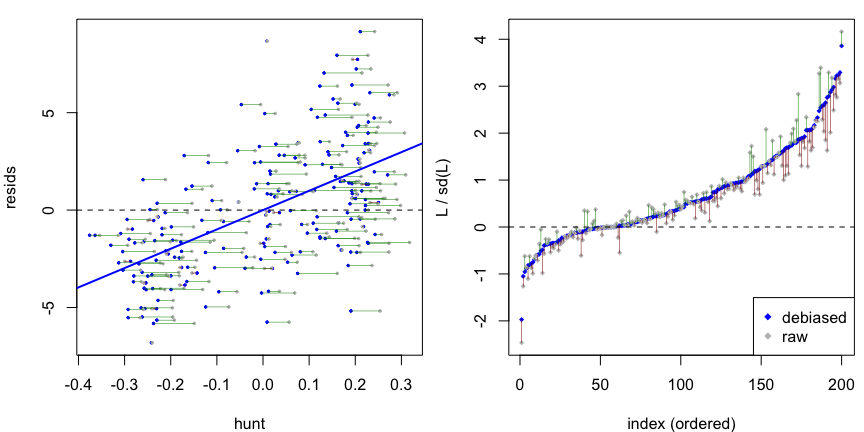
plot(res)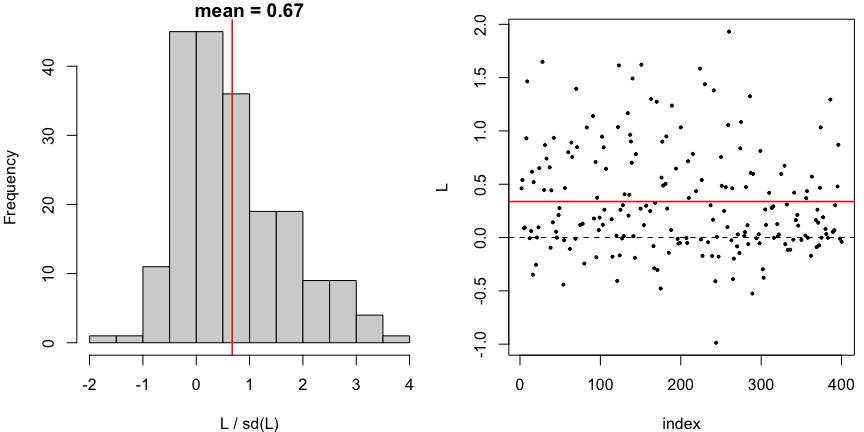
The methodology is described in:
Dhawan, A., Guo, F. R. and Shah, R. D. (2026). The debiased score test: hunt-and-test for semiparametric hypotheses. arXiv:2607.28861. https://arxiv.org/abs/2607.28861
citation("dScoreTest")These binaries (installable software) and packages are in development.
They may not be fully stable and should be used with caution. We make no claims about them.
Health stats visible at Monitor.