The hardware and bandwidth for this mirror is donated by dogado GmbH, the Webhosting and Full Service-Cloud Provider. Check out our Wordpress Tutorial.
If you wish to report a bug, or if you are interested in having us mirror your free-software or open-source project, please feel free to contact us at mirror[@]dogado.de.



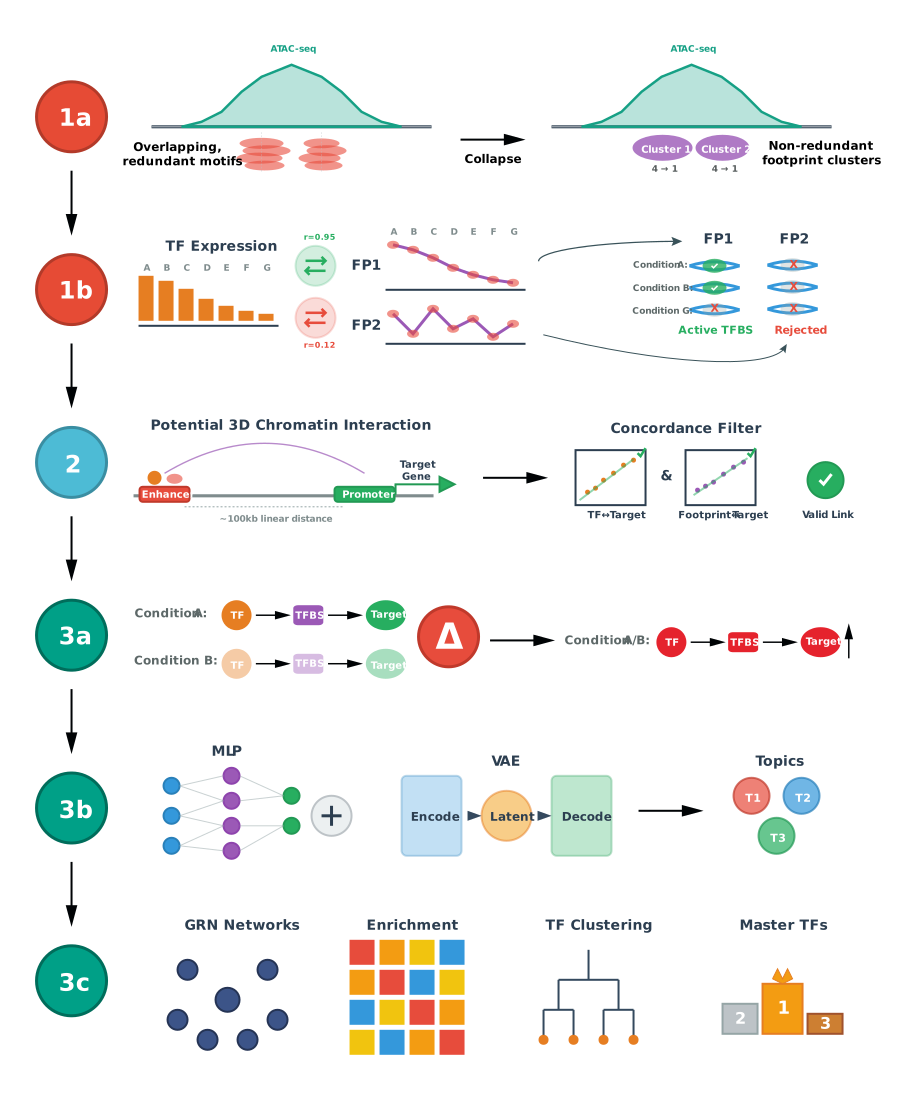
CraftGRN is a modular framework for integrating chromatin accessibility profiles from ATAC-seq with matched RNA-seq expression data to infer condition-specific transcription factor binding sites and reconstruct dynamic gene regulatory networks.
CraftGRN helps users:
CraftGRN can be installed from GitHub:
# Using remotes
remotes::install_github("oncologylab/craftgrn")

# or using pak
pak::pak("oncologylab/craftgrn")
Common CRAN and Bioconductor dependencies can be installed with:
install.packages(c("igraph", "ggplot2", "data.table", "BiocManager"))
BiocManager::install(c("DESeq2", "GenomicRanges", "SummarizedExperiment"))CraftGRN keeps demo datasets outside the source package so installation remains small and CRAN-friendly. The package helper reports any configured external demo bundles:
craftgrn::craftgrn_demo_data_info()No external demo bundle is currently configured. To run your own project, point CraftGRN at a project-level YAML file:
config <- "project.yaml"
module1_dir <- file.path(tempdir(), "predict_tf_binding_sites")

omics <- craftgrn::load_prep_multiomic_data(
  config = config,
  label_col = "strict_match_rna",
  do_preprocess = FALSE,
  verbose = TRUE
)

module1 <- craftgrn::predict_tfbs(
  omics_data = omics,
  out_dir = module1_dir,
  output_format = "auto",
  write_outputs = TRUE,
  write_stats = FALSE,
  verbose = TRUE
)
Troubleshooting:
craftgrn_demo_data_info() returns zero rows, no
public demo bundle is currently advertised by this package version.project.yaml in the project directory and pass that config
path explicitly. A portable project config should use
base_dir: ".".load_prep_multiomic_data() and Module 1 before running
Module 2.CraftGRN is organized as a three-module workflow.
Module 1 loads matched ATAC, RNA, metadata, and optional footprint score files, then prepares a multiomic data object for downstream regulatory analysis.
Primary package functions:
load_prep_multiomic_data() loads, filters, aligns, and
prepares multiomic inputs from a YAML configuration file. When outputs
are enabled, it also writes 01_fp_scores_qn_<db>.csv,
the quantile-normalized footprint score matrix used downstream.predict_tfbs() performs direct-bound footprint
filtering and TF binding site prediction across matched conditions.build_module1_qc_report() writes an HTML QC report for
run parameters, input gates, canonical support, correlation diagnostics,
predicted TFBS chunk integrity, top TFs/FPs, condition support, warning
checks, and related Module 1 artifacts. The report uses multiple static
plot types, including processing funnels, density curves, scatter
summaries, heatmaps, lollipop rank plots, and cumulative curves.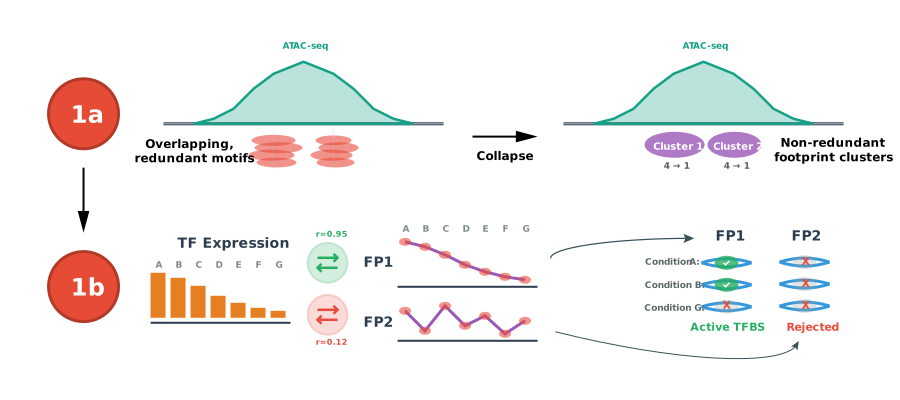
Module 2 links TF binding sites to candidate target genes using enhancer-gene maps, genomic distance windows, or 3D chromatin interaction priors. Candidate TF->TFBS->target links are filtered by condition-specific expression, binding, footprint or peak signal, and cross-condition correlation evidence.
Primary package functions:
predict_tf_targets() predicts TF target genes from
predicted TFBS, TF-target correlations, FP-target correlations, genomic
proximity, and optional regulatory priors.build_module2_qc_report() writes an HTML QC report for
compact handoff checks, TF-target and FP-target filters, candidate
source and distance-to-TSS evidence, final-link integrity, condition
activity, warning checks, top TF/target/FP summaries, and related
browser reports. The report combines relational flow diagrams, density
and cumulative distance plots, scatter summaries, heatmaps, and lollipop
rank plots.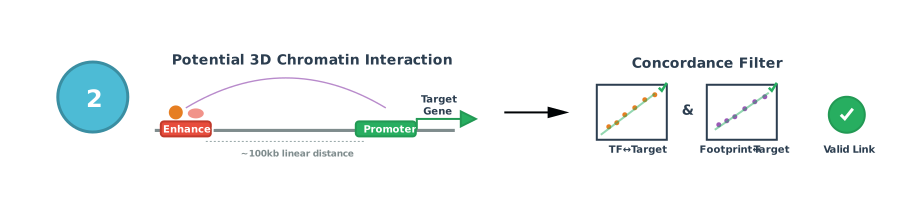
Module 3 compares condition-specific regulatory links, builds joint RNA and footprint document-term matrices, trains topic models, assigns regulatory links to topics, and summarizes pathway and master TF programs.
Primary package functions:
run_topic_modeling() runs one selected Module 3
topic-document method with a flat standard output layout, compact
topic-link outputs, and a QC report. The selected method, K value or K
grid, WarpLDA iterations, and topic-link output mode can be stored in
the project YAML config.module3_prepare_differential_links() prepares filtered
differential links from Module 2 predicted links and condition
comparisons.module3_construct_docs() builds reusable
topic-document, document-term, and sparse matrix caches for step-by-step
inspection.module3_train_topic_models() trains regulatory topic
models across a user-defined topic-number grid using the native
warp_omp WarpLDA sampler by default. Use
warplda_sampler = "warp_ref" only when you need a slower
sequential fixed-seed reference run from the native backend.module3_extract_topics() assigns links and terms to
selected regulatory topics.build_module3_qc_report() summarizes topic inputs,
model outputs, differential links, and top differential TFs.visualize_topic_modeling_results() exports
topic-modeling review browsers, and
visualize_differential_grns() exports an interactive
differential GRN network browser with comparison, direction, Top TF, and
Top link controls.For regular package runs, keep one selected Module 3 setup in
project.yaml, for example:
topic_method: comparison_aggr_multivi
topic_k: 10
warplda_iterations: 2000
topic_link_output: pass
pathway_backend: enrichly

topic_benchmark_enabled: false
topic_benchmark_methods: []
topic_benchmark_k_grid: []
pathway_backend: enrichly uses local cached pathway
libraries when the optional enrichly package is installed;
pathway_backend: enrichr keeps the web API backend.
Benchmark grids are optional and should be enabled only for
method-comparison experiments.
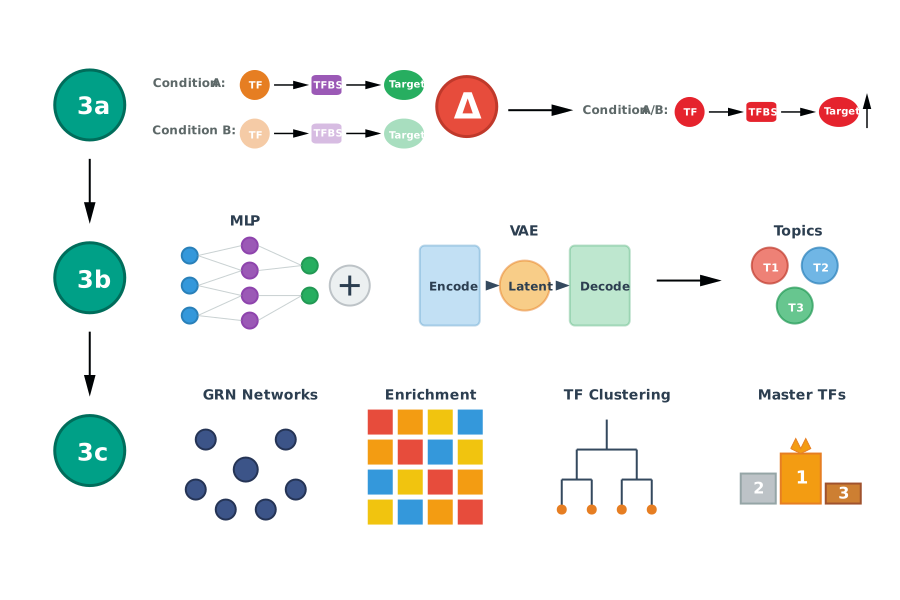
For a module-by-module tutorial, see the Get started article.
Li, Y., Yi, C. et al. (in preparation). CraftGRN: Integrative ATAC-RNA framework for condition-specific gene regulatory network analysis.
This project is licensed under the GNU General Public License v3.0.
These binaries (installable software) and packages are in development.
They may not be fully stable and should be used with caution. We make no claims about them.
Health stats visible at Monitor.