


The hardware and bandwidth for this mirror is donated by dogado GmbH, the Webhosting and Full Service-Cloud Provider. Check out our Wordpress Tutorial.
If you wish to report a bug, or if you are interested in having us mirror your free-software or open-source project, please feel free to contact us at mirror[@]dogado.de.
baselinr applies the group-design determinations of the
What Works Clearinghouse
(WWC) to education impact studies, following the conventions of its
Procedures and Standards Handbooks. It computes the WWC effect sizes
(Hedges’ g for continuous covariates, the Cox
index for binary ones) and baseline-equivalence categories,
classifies attrition against the WWC boundary, returns
the group-design study rating, and reports how stable a
baseline-equivalence verdict is to defensible computation choices.
It is a small, education-specific package. For general-purpose
covariate balance assessment, see cobalt;
baselinr focuses on the WWC determinations that education
evaluation reports are required to state.
Install the released version from CRAN:
install.packages("baselinr")Or the development version from GitHub:
# install.packages("remotes")
remotes::install_github("zl1212-ship-it/baselinr")library(baselinr)
study <- data.frame(
treat = c(1, 1, 1, 0, 0, 0),
pretest = c(5, 6, 7, 4, 5, 6), # continuous -> Hedges' g
female = c(1, 0, 1, 0, 0, 1) # binary -> Cox index
)
knitr::kable(baseline_equivalence(study, treatment = "treat"), digits = 3)| covariate | type | n_treatment | n_comparison | mean_treatment | mean_comparison | sd_treatment | sd_comparison | effect_size | wwc_category |
|---|---|---|---|---|---|---|---|---|---|
| pretest | continuous | 3 | 3 | 6.000 | 5.000 | 1.000 | 1.000 | 0.80 | not_satisfied |
| female | binary | 3 | 3 | 0.667 | 0.333 | 0.577 | 0.577 | 0.84 | not_satisfied |
The WWC categories are:
| Effect size (absolute) | Category | Meaning |
|---|---|---|
<= 0.05 |
satisfied |
Baseline equivalence holds. |
0.05–0.25 |
satisfied_with_adjustment |
Holds only if the covariate is adjusted for in the impact model. |
> 0.25 |
not_satisfied |
Cannot establish equivalence. |
love_plot() shows the standardized effect size of every
covariate against the WWC thresholds (requires
ggplot2):
love_plot(baseline_equivalence(study, treatment = "treat"))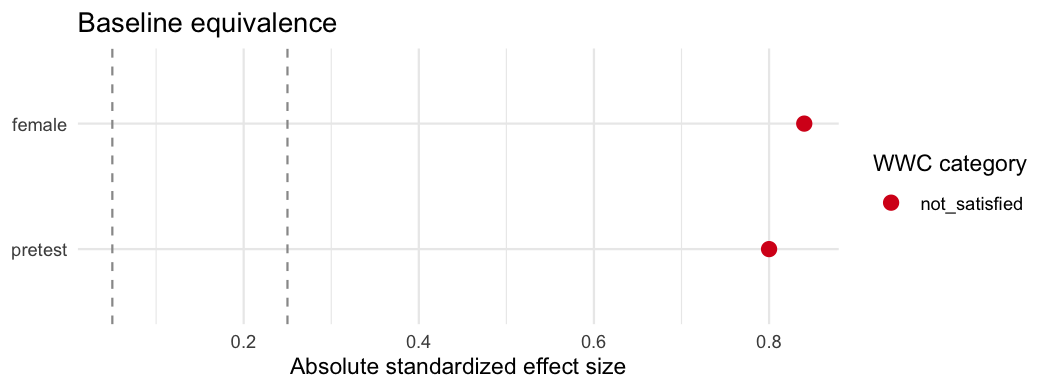
gt_baseline() renders the same table as a formatted
gt table for reports and Quarto/HTML (requires
gt):
gt_baseline(baseline_equivalence(study, treatment = "treat"))Continuous covariates use Hedges’ g (with the WWC small-sample
correction); binary covariates (numeric 0/1, logical, or
two-level factor) use the WWC Cox index. wwc_summary()
collapses the covariate table into an overall verdict. Beyond baseline
equivalence, attrition() and
attrition_boundary() report and classify sample attrition
against the WWC boundary, cluster_correction() computes the
WWC clustering correction for mismatched analyses,
wwc_rating() returns the group-design study rating, and
wwc_robustness() reports whether a baseline-equivalence
verdict holds up under defensible alternative computations. See
NEWS.md for the roadmap.
If you use baselinr in your work, please cite it: run
citation("baselinr") in R for the full reference, or use
the “Cite this repository” button on GitHub. If you use baselinr in
research or practice, I would love to hear about it:
zl1212@uw.edu.
MIT © Yuxia Liang
These binaries (installable software) and packages are in development.
They may not be fully stable and should be used with caution. We make no claims about them.
Health stats visible at Monitor.