 R package arulesNBMiner - Mining NB-Frequent Itemsets and NB-Precise
Rules
R package arulesNBMiner - Mining NB-Frequent Itemsets and NB-Precise
RulesThe hardware and bandwidth for this mirror is donated by dogado GmbH, the Webhosting and Full Service-Cloud Provider. Check out our Wordpress Tutorial.
If you wish to report a bug, or if you are interested in having us mirror your free-software or open-source project, please feel free to contact us at mirror[@]dogado.de.
R package arulesNBMiner - Mining NB-Frequent Itemsets and NB-Precise
Rules

Maintainer: Michael Hahsler
This R package extends arules with
NBMiner, an implementation of the model-based mining algorithm for
NB-frequent itemsets described in Michael Hahsler’s paper, “A model-based
frequency constraint for mining associations from transaction data.”
Data Mining and Knowledge Discovery, 13(2):137-166, September
2006.
This algorithm dynamically chooses support for itemsets based on the deviation from a fitted independence model. NBMiner is better at suppressing spurious patters and finds interesting patterns with lower support compared to the traditional minimum support-based algorithms.
Stable CRAN version: Install from within R with
install.packages("arulesNBMiner")Current development version: Install from r-universe.
install.packages("arulesNBMiner",
    repos = c("https://mhahsler.r-universe.dev",
"https://cloud.r-project.org/"))Estimate negative binomial distribution (NBD) model parameters for the arules Groceries data set.
library("arulesNBMiner")
data("Groceries")

param <- NBMinerParameters(Groceries, trim = 0.1)
## 17 item(s) trimmed, leaving 152 items.
## using Expectation Maximization for missing zero class
## iteration = 1 , zero class = 2 , k = 0.86 , m = 153
## total items = 154
##
## Goodness of fit/chi-square test on binned count data
## H0: Observed counts match the expected proportions.
## Bins: 10
## X-squared = 6.6 with 9 degrees of freedom
## p.value = 0.68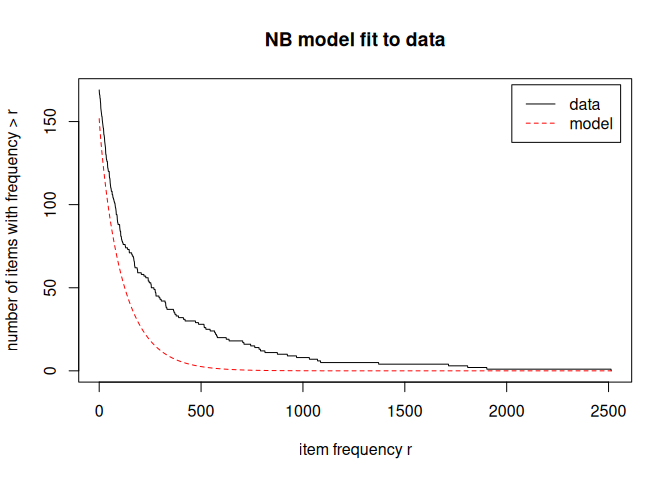 Note
that the model shows independence but the dataset contains a significant
amount of correlated items shown by the larger cumulative frequency.
Note
that the model shows independence but the dataset contains a significant
amount of correlated items shown by the larger cumulative frequency.
Mine NB-frequent itemsets
itemsets_NB <- NBMiner(Groceries, parameter = param, minlen = 2L)
itemsets_NB
## set of 2881 itemsetsAdd support and inspect some NB-frequent itemsets with the highest precision.
quality(itemsets_NB) <- cbind(quality(itemsets_NB), support = interestMeasure(itemsets_NB,
    "support", transactions = Groceries))

inspect(head(itemsets_NB, by = "precision"))
## items precision support
## [1] {bottled beer, liquor, red/blush wine} 1 0.00193
## [2] {bottled beer, liquor} 1 0.00468
## [3] {soda, bottled beer, liquor, red/blush wine} 1 0.00081
## [4] {whole milk, curd} 1 0.02613
## [5] {whole milk, rolls/buns, margarine} 1 0.00793
## [6] {whole milk, butter} 1 0.02755A precision close to 1 means that there is very little chance that they are spurious. We see that some very low support itemsets are under the top NB-frequent itemsets.
These binaries (installable software) and packages are in development.
They may not be fully stable and should be used with caution. We make no claims about them.
Health stats visible at Monitor.