

The hardware and bandwidth for this mirror is donated by dogado GmbH, the Webhosting and Full Service-Cloud Provider. Check out our Wordpress Tutorial.
If you wish to report a bug, or if you are interested in having us mirror your free-software or open-source project, please feel free to contact us at mirror[@]dogado.de.
actiwalkability provides helpers for querying the EPA
Walkability Index and working with Census GEOID/FIPS identifiers.
Core entry points:
ww_epa_walkability() for querying the EPA Walkability
Index ArcGIS layerww_fips15() and ww_fips12() for composing
Census FIPS/GEOID stringsYou can install actiwalkability from GitHub with:
# install.packages("remotes")
remotes::install_github("jhuwit/actiwalkability")The EPA index is reported for Census block groups. Start with an address lookup that contains 12-character, Census 2010 block-group GEOIDs; keep these identifiers as character values so leading zeroes are retained.
library(actiwalkability)

addresses <- dplyr::tibble(
  address_id = c("address_1", "address_2", "address_3"),
  geoid = c("240054519002", "240054026041", "245102303002")
)

knitr::kable(addresses)| address_id | geoid |
|---|---|
| address_1 | 240054519002 |
| address_2 | 240054026041 |
| address_3 | 245102303002 |
If state, county, tract, and block identifiers are available instead,
create a block-group GEOID with acti_fips12():
acti_fips12(state = 24, county = 510, tract = 60400, block = 2002)
#> [1] "245100604002"
Query the EPA layer with the unique GEOIDs. This is a live service
request; the chunk is cached so subsequent README renders
reuse the saved result.
walkability <- acti_epa_walkability(
  unique(addresses$geoid),
  geometry = FALSE,
  fields = c("GEOID10", "NatWalkInd")
)knitr::kable(dplyr::select(
as.data.frame(walkability),
GEOID10, NatWalkInd, cat_walk_index
))| GEOID10 | NatWalkInd | cat_walk_index |
|---|---|---|
| 240054519002 | 4.166667 | [1,5.75] |
| 245102303002 | 14.333333 | (10.5,15.2] |
| 240054026041 | 8.666667 | (5.75,10.5] |
Join the returned index values back to the address lookup:
address_walkability <- dplyr::left_join(
  addresses,
  walkability,
  by = c("geoid" = "GEOID10")
)

knitr::kable(dplyr::select(
  address_walkability,
  address_id, geoid, NatWalkInd, cat_walk_index
))| address_id | geoid | NatWalkInd | cat_walk_index |
|---|---|---|---|
| address_1 | 240054519002 | 4.166667 | [1,5.75] |
| address_2 | 240054026041 | 8.666667 | (5.75,10.5] |
| address_3 | 245102303002 | 14.333333 | (10.5,15.2] |
The EPA values are joined to Census TIGERweb 2010
block-group boundaries, the boundary vintage that matches
GEOID10. The hard-coded plot extent provides the wider
Baltimore, Maryland context, while keeping the README
dependencies small. This query is cached in the README.
census_block_groups <- arcgislayers::arc_open(
  "https://tigerweb.geo.census.gov/arcgis/rest/services/Census2020/Tracts_Blocks/MapServer/5"
)
census_where <- paste0(
  "GEOID IN (",
  paste0("'", unique(addresses$geoid), "'", collapse = ", "),
  ")"
)
block_groups_2010 <- arcgislayers::arc_select(
  census_block_groups,
  where = census_where,
  geometry = TRUE,
  fields = c("GEOID", "INTPTLAT", "INTPTLON")
) |>
  dplyr::rename(GEOID10 = GEOID)

walkability_map <- dplyr::left_join(
  block_groups_2010,
  dplyr::select(as.data.frame(walkability), GEOID10, NatWalkInd),
  by = "GEOID10"
)

walkability_labels <- dplyr::mutate(
  as.data.frame(walkability_map),
  longitude = as.numeric(INTPTLON),
  latitude = as.numeric(INTPTLAT)
)

ggplot2::ggplot() +
  ggplot2::geom_sf(
    data = walkability_map,
    ggplot2::aes(fill = NatWalkInd),
    colour = "white"
  ) +
  ggrepel::geom_text_repel(
    data = walkability_labels,
    ggplot2::aes(longitude, latitude, label = GEOID10),
    seed = 2026,
    min.segment.length = 0,
    size = 3
  ) +
  ggplot2::scale_fill_viridis_c(name = "Walkability\nindex") +
  ggplot2::coord_sf(
    crs = 4326,
    default_crs = 4326,
    xlim = c(-77, -76.1),
    ylim = c(39, 39.7),
    expand = FALSE
  ) +
  ggplot2::labs(
    title = "Example Census block groups in Baltimore, Maryland",
    subtitle = "EPA National Walkability Index"
  ) +
  ggplot2::theme_minimal()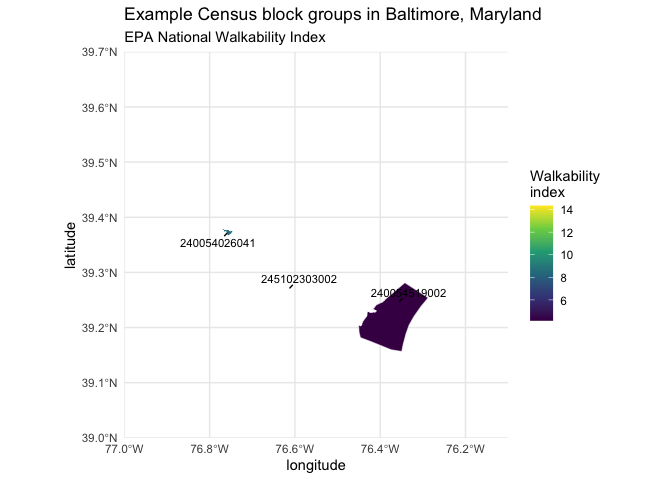
These binaries (installable software) and packages are in development.
They may not be fully stable and should be used with caution. We make no claims about them.
Health stats visible at Monitor.