
The hardware and bandwidth for this mirror is donated by dogado GmbH, the Webhosting and Full Service-Cloud Provider. Check out our Wordpress Tutorial.
If you wish to report a bug, or if you are interested in having us mirror your free-software or open-source project, please feel free to contact us at mirror[@]dogado.de.



phinterval is a package for representing and manipulating time spans
that may contain gaps. It implements the <phinterval>
(think “potentially-holey-interval”) vector class, designed as an
extension of the {lubridate}
<Interval>, to represent spans of time that are
contiguous, disjoint, empty, or missing.
Functionality for manipulating these spans includes:
Install the released version from CRAN with:
install.packages("phinterval")You can install the development version of phinterval from GitHub with:
# install.packages("pak")
pak::pak("EthanSansom/phinterval")Each element of a <phinterval> vector is a set of
non-overlapping and non-adjacent intervals. For scalar intervals (one
span per element), phinterval() works like
lubridate::interval():
library(phinterval)
library(lubridate, warn.conflicts = FALSE)

# Create scalar phintervals (equivalent to interval())
phinterval(
  start = ymd(c("2000-01-01", "2000-01-03", "2000-01-04")),
  end = ymd(c("2000-01-02", "2000-01-05", "2000-01-09"))
)
#> <phinterval<UTC>[3]>
#> [1] {2000-01-01--2000-01-02} {2000-01-03--2000-01-05} {2000-01-04--2000-01-09}
To create phintervals with multiple disjoint spans per element, use
the by argument to group intervals. Overlapping or adjacent
spans within each group are automatically merged:
# Create a phinterval with disjoint spans using the by argument
phint <- phinterval(
  start = ymd(c("2000-01-03", "2000-01-01", "2000-01-04")),
  end = ymd(c("2000-01-05", "2000-01-02", "2000-01-09")),
  by = c(1, 2, 2)
)
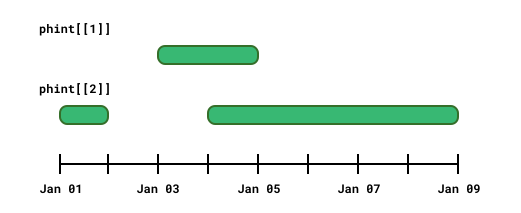
phint
#> <phinterval<UTC>[2]>
#> [1] {2000-01-03--2000-01-05}
#> [2] {2000-01-01--2000-01-02, 2000-01-04--2000-01-09}
Graphically, the elements of phint are represented
as:
In most cases, a <phinterval> vector will appear
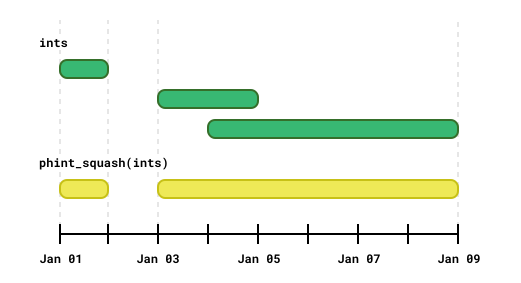
as the result of manipulating <Interval> vectors. For
example, phint_squash() flattens a vector of time spans
into a scalar <phinterval>.
jan_1_to_9 <- interval(ymd("2000-01-01"), ymd("2000-01-09"))
jan_1_to_2 <- interval(ymd("2000-01-01"), ymd("2000-01-02"))
jan_3_to_5 <- interval(ymd("2000-01-03"), ymd("2000-01-05"))
jan_4_to_9 <- interval(ymd("2000-01-04"), ymd("2000-01-09"))

ints <- c(jan_1_to_2, jan_3_to_5, jan_4_to_9)
phint_squash(ints)
#> <phinterval<UTC>[1]>
#> [1] {2000-01-01--2000-01-02, 2000-01-03--2000-01-09}
The squashed intervals contain the set of time spans within any of the input intervals, without duplication.
The phinterval package is most useful when working with tabular data, such as a longitudinal employment panel.
library(dplyr, warn.conflicts = FALSE)

jobs <- tribble(
  ~name,   ~job_title,             ~start,        ~end,
  "Greg",  "Mascot",               "2018-01-01",  "2018-06-03",
  "Greg",  "Executive Assistant",  "2018-06-10",  "2020-04-01",
  "Shiv",  "Political Consultant", "2017-01-01",  "2019-04-01"
)

employment <- jobs |>
  # Squash overlapping/adjacent intervals into a single phinterval
  group_by(name) |>
  summarize(employed = datetime_squash(ymd(start), ymd(end))) |>
  # Invert the employment timeline to find gaps
  mutate(unemployed = phint_invert(employed))

employment
#> # A tibble: 2 × 3
#>   name  employed                    unemployed
#>   <chr> <phint<UTC>>                <phint<UTC>>
#> 1 Greg  {2018-01-01-[2]-2020-04-01} {2018-06-03--2018-06-10}
#> 2 Shiv  {2017-01-01--2019-04-01}    <hole>
<phinterval> column formatting adapts to the
available console width. The "[2]" in Greg’s employment
interval "{2018-01-01-[2]-2020-04-01}" indicates that his
employment history is made up of two disjoint spans, with the first span
beginning on 2018-01-01 and the second ending on 2020-04-01. When more
space is available, every span is shown explicitly.
employment |> select(name, employed)
#> # A tibble: 2 × 2
#>   name  employed
#>   <chr> <phint<UTC>>
#> 1 Greg  {2018-01-01--2018-06-03, 2018-06-10--2020-04-01}
#> 2 Shiv  {2017-01-01--2019-04-01}
Operations on <phinterval> vectors behave like
those on standard intervals. Here, we can see that there was a 7-day gap
in Greg’s employment history:
employment |>
  mutate(
    days_employed = employed / ddays(1),
    days_unemployed = unemployed / ddays(1)
  ) |>
  select(name, days_employed, days_unemployed)
#> # A tibble: 2 × 3
#>   name  days_employed days_unemployed
#>   <chr>         <dbl>           <dbl>
#> 1 Greg            814               7
#> 2 Shiv 820 0The <phinterval> class is a generalization of the
<Interval> class, meaning any
<Interval> can be converted into an equivalent
<phinterval> and all phinterval functions accept
either <Interval> or <phinterval>
inputs. The table below shows the lubridate functions that have drop-in
phinterval replacements.
| phinterval | lubridate | Returns |
|---|---|---|
phinterval(start, end) |
interval(start, end) |
Spans bounded by start/end |
phint_intersect(x, y) |
intersect(x, y) |
Times in x and y |
phint_setdiff(x, y) |
setdiff(x, y) |
Times in x, but not in y |
phint_union(x, y) |
union(x, y) |
Times in x or y |
phint_start(x) |
int_start(x) |
The start time of x |
phint_end(x) |
int_end(x) |
The end time of x |
phint_length(x) |
int_length(x) |
The number of seconds in x |
phint_overlaps(x, y) |
int_overlaps(x, y) |
Whether x and y intersect |
phint_within(x, y) |
x %within% y |
Whether y contains x |
x / duration(...) |
x / duration(...) |
How many durations fit in x |
All phinterval set operations work as expected with arbitrary time
spans, enabling operations that are not supported by lubridate. For
example, the intersection of two non-overlapping intervals is an empty
time span, called a <hole>.
lubridate::intersect(jan_1_to_2, jan_4_to_9)
#> [1] NA--NA
phint_intersect(jan_1_to_2, jan_4_to_9)
#> <phinterval<UTC>[1]>
#> [1] <hole>
The set-difference of a time span and itself is also a
<hole>.
lubridate::setdiff(jan_1_to_2, jan_1_to_2)
#> [1] 2000-01-01 UTC--2000-01-02 UTC
phint_setdiff(jan_1_to_2, jan_1_to_2)
#> <phinterval<UTC>[1]>
#> [1] <hole>
Performing a set-difference may “punch a hole” in a time span, creating a discontinuous interval.
try(lubridate::setdiff(jan_1_to_9, jan_3_to_5))
#> Error in setdiff.Interval(jan_1_to_9, jan_3_to_5) :
#>   Cases 1 result in discontinuous intervals.
phint_setdiff(jan_1_to_9, jan_3_to_5)
#> <phinterval<UTC>[1]>
#> [1] {2000-01-01--2000-01-03, 2000-01-05--2000-01-09}
The union of two disjoint intervals is a single
<phinterval> containing two spans.
lubridate::union(jan_1_to_2, jan_4_to_9)
#> [1] 2000-01-01 UTC--2000-01-09 UTC
phint_union(jan_1_to_2, jan_4_to_9)
#> <phinterval<UTC>[1]>
#> [1] {2000-01-01--2000-01-02, 2000-01-04--2000-01-09}
As with the lubridate equivalents, all phinterval set operations are vectorized.
phint_intersect(
  c(jan_1_to_2, jan_3_to_5, jan_1_to_2),
  c(jan_1_to_9, jan_4_to_9, jan_4_to_9)
)
#> <phinterval<UTC>[3]>
#> [1] {2000-01-01--2000-01-02} {2000-01-04--2000-01-05} <hole>This package builds on {lubridate}’s
<Interval> class for representing contiguous time
spans. The prototype <phinterval> data structure (a
list of matrices) and the C++ implementation of
phint_squash() were inspired by the {intervals}
package by Richard Bourgon and Edzer Pebesma. The figures used in this
README were inspired by Davis Vaughan’s {ivs} package
documentation.
These binaries (installable software) and packages are in development.
They may not be fully stable and should be used with caution. We make no claims about them.
Health stats visible at Monitor.