
The hardware and bandwidth for this mirror is donated by dogado GmbH, the Webhosting and Full Service-Cloud Provider. Check out our Wordpress Tutorial.
If you wish to report a bug, or if you are interested in having us mirror your free-software or open-source project, please feel free to contact us at mirror[@]dogado.de.
pdfsigner is an R package to digitally sign PDF documents with a PKCS#12 keystore and verify their signatures.
The package is powered by a bundled, pure-Rust
backend (the pdf_signer
crate, wrapped with extendr). It no
longer shells out to Java (BatchPDFSignPortable.jar) or
Poppler (pdfsig): no Java runtime, OpenSSL, or
external command-line tools are required — only a Rust
toolchain at install time.
Requires a Rust toolchain (cargo, rustc) to
compile the bundled backend. Install Rust from https://rustup.rs, then:
# install.packages("remotes")
remotes::install_github("StrategicProjects/pdfsigner")pades_level: "bb" (CAdES
signing-certificate-v2), "bt" (+ RFC 3161
signature timestamp), "blt" (+ a /DSS with the
certificate chain and CRLs), "blta" (+ a document timestamp
over the whole file). Levels "bt"+ need a
tsa_url.sign_pdf()library(pdfsigner)
sign_pdf(
pdf_file = "input.pdf",
output_file = "signed.pdf",
keystore_path = "keystore.p12", # or env var KEYSTORE_PATH
keystore_password = "password", # or env var KEY_PASSWORD
signtext = "Document digitally signed by CastLab",
validate_link = "https://castlab.org/validate",
reason = "Approval",
translate = TRUE, # Portuguese date label
font = "Arial.ttf", # embed a TrueType/OpenType font
image = "logo.png", # draw a PNG/JPEG logo in the box
tsa_url = "http://timestamp.digicert.com",
pades_level = "blta" # bb | bt | blt | blta
)A visible signature box is drawn whenever
signtext is non-empty; geometry is controlled by
page, x, y, width,
height, font_size and border.
Pass font to embed a TrueType/OpenType font
(WinAnsi/Latin-1 glyphs; the default is Helvetica) and
image to draw a PNG/JPEG logo in the box. Omit
signtext for an invisible signature.
verify_pdf_signature()result <- verify_pdf_signature("signed.pdf")
length(result) # number of signatures
vapply(result, function(s) s$valid, logical(1))
result[[1]]$signer # signer distinguished nameEach entry is a named list: valid, signer,
chain_trusted, covers_whole_document,
signed_len, byte_range,
detail.
Pass roots (a PEM file of trusted roots, e.g. the
ICP-Brasil AC Raiz set) to validate each signer certificate chain;
chain_trusted is then TRUE/FALSE
(and NA when no roots are given):
verify_pdf_signature("signed.pdf", roots = "icp-brasil-roots.pem")TSA / CRL endpoints over HTTPS are supported (the
bundled Rust backend is built with its https feature, using
rustls).
openssl req -x509 -newkey rsa:2048 -keyout key.pem -out cert.pem -days 365 -nodes
openssl pkcs12 -export -inkey key.pem -in cert.pem -out keystore.p12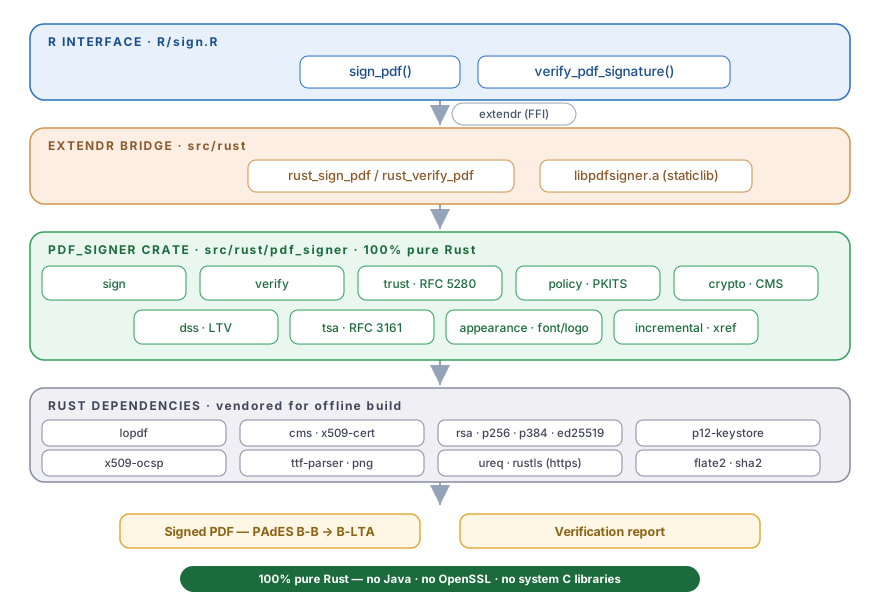
The R functions call a thin extendr
bridge that links the pure-Rust pdf_signer
crate. Every Rust dependency is vendored under
src/rust/vendor.tar.xz so the package builds offline (CRAN
policy: SystemRequirements: Cargo, rustc).
GPL-3. The bundled pdf_signer crate and its vendored
Rust dependencies retain their own licenses.
These binaries (installable software) and packages are in development.
They may not be fully stable and should be used with caution. We make no claims about them.
Health stats visible at Monitor.