
The hardware and bandwidth for this mirror is donated by dogado GmbH, the Webhosting and Full Service-Cloud Provider. Check out our Wordpress Tutorial.
If you wish to report a bug, or if you are interested in having us mirror your free-software or open-source project, please feel free to contact us at mirror[@]dogado.de.
netify is an R package for working with relational data. It converts edge lists, matrices, and data frames into network objects that you can analyze and visualize using a consistent set of functions.
We built netify while doing our own network research in social science. It handles common tasks like temporal network analysis, ego network extraction, and multiplex relationships without requiring multiple packages or data format conversions.
Install the package from CRAN after release:
install.packages("netify")Install the development version from GitHub:
install.packages("devtools")
devtools::install_github("netify-dev/netify", dependencies = TRUE)Transform your relational data into a network object with just one function:
library(netify)
data(icews)

# Create a network from dyadic data
icews_conflict <- netify(
  icews,
  actor1 = 'i',
  actor2 = 'j',
  time = 'year',
  symmetric = FALSE,
  weight = 'matlConf',
  nodal_vars = c('i_polity2', 'i_log_gdp', 'i_region')
)

# Print the netify object
print(icews_conflict)
✔ Network data created.
• Unipartite
• Asymmetric
• Weights from `matlConf`
• Longitudinal: 13 Periods
• # Unique Actors: 152
Network Summary Statistics (averaged across time):
dens miss mean recip trans
matlConf 0.113 0 12.997 0.594 0.387
• Nodal Features: i_polity2, i_log_gdp, i_region
• Dyad Features: None# Plot the network
plot(icews_conflict)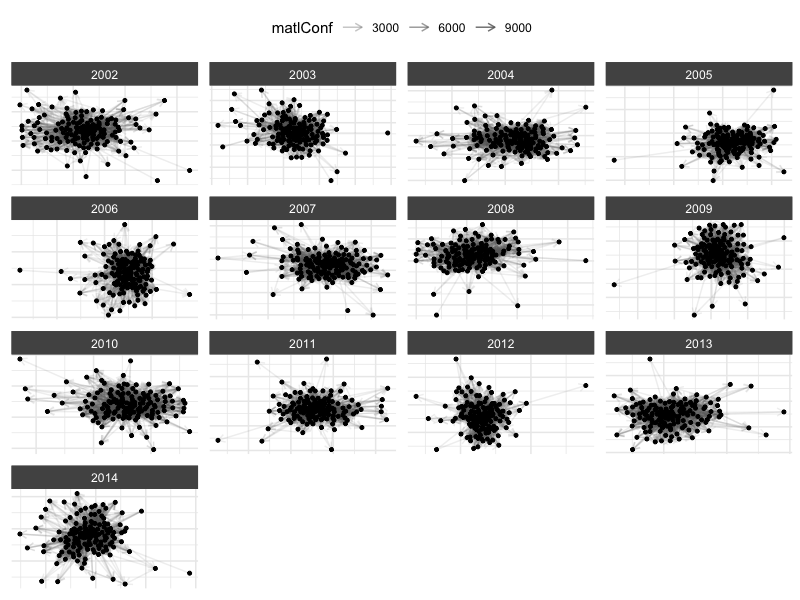
You can map node attributes to plot aesthetics:
# Create democracy indicator
icews$i_democ <- factor(
  ifelse(icews$i_polity2 >= 6, 1, 0),
  levels = c(0, 1),
  labels = c("Non-democracy", "Democracy")
)

# Add it to the network
icews_conflict <- add_node_vars(
  icews_conflict, icews,
  actor = 'i', time = 'year',
  node_vars = 'i_democ'
)

plot(
  icews_conflict,
  # Log transform weights
  mutate_weight = log1p,
  # Map node attributes to aesthetics
  node_color_by = 'i_region',
  node_size_by = 'i_log_gdp',
  node_shape_by = 'i_democ',
  # set global node alpha
  node_alpha = .7,
  # set global edge alpha
  edge_linewidth = .1,
  # Filter data
  node_filter = ~ !is.na(i_democ),
  time_filter = c('2002', '2004', '2008', '2014'),
  # clean up plot labels
  edge_alpha_label = 'Log(Matl.\n Conf.)',
  node_color_label = '',
  node_size_label = 'Log(GDP)',
  node_shape_label = ''
  ) +
  ggplot2::theme(legend.position = 'right') +
  ggplot2::scale_color_brewer(palette = 'Set1')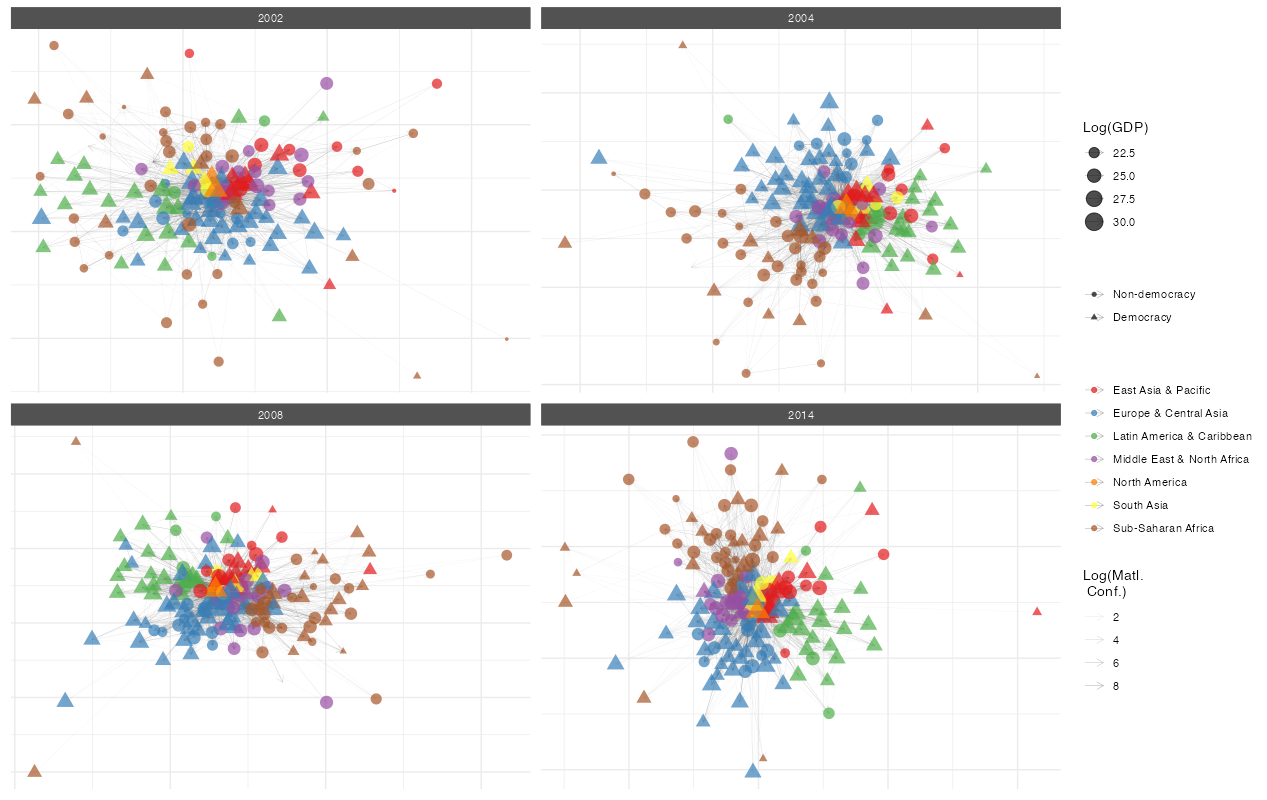
summary(icews_conflict)This returns a data frame with network statistics for each time period:
| Year | Actors | Density | Edges | Mean Weight | Reciprocity | Transitivity |
|---|---|---|---|---|---|---|
| 2002 | 152 | 0.090 | 2069 | 1.12 | 0.200 | 0.354 |
| 2003 | 152 | 0.095 | 2193 | 1.54 | 0.294 | 0.358 |
| 2004 | 152 | 0.115 | 2666 | 1.64 | 0.647 | 0.391 |
| … | … | … | … | … | … | … |
(Table shows first few rows - actual output includes all time periods)
netify() - Turn your data into a network objectego_netify() - Extract ego networkslayer_netify() - Stack multiple relationships into
multilayer networksadd_node_vars() - Attach attributes to actors (like
GDP, democracy scores)add_dyad_vars() - Attach attributes to relationships
(like trade volume, conflict events)subset() - Pull out specific time periods or
actorsmutate_weights() - Log-transform, normalize, or
otherwise modify edge weightsmeasurements() - Measurements of your network size and
compositionsummary() - Get a quick overview of your networksummary_actor() - See how individual actors fit into
the networkcompare_networks() - See how similar two networks
arehomophily() - Do similar actors tend to connect?mixing_matrix() - Who connects with whom?plot() - Create network diagrams with sensible
defaultsplot_actor_stats() - Visualize node-level
statisticsplot_graph_stats() - Show how network properties change
over timeto_igraph() / to_network() - When you need
something we don’t haveto_amen() - For fitting AME or SRM modelsunnetify() - Get back to a regular data frame| Task | Function | Example |
|---|---|---|
| Create network | netify() |
netify(data, actor1="from", actor2="to") |
| Extract ego network | ego_netify() |
ego_netify(net, ego="USA") |
| Create multilayer | layer_netify() |
layer_netify(list(net1, net2)) |
| Add node data | add_node_vars() |
add_node_vars(net, node_df, actor="id") |
| Add dyad data | add_dyad_vars() |
add_dyad_vars(net, dyad_df, actor1="from", actor2="to") |
| Subset network | subset() |
subset(net, time="2020") |
| Get graph level summary statistics | summary() |
summary(net) |
| Get actor level summary statistics | summary_actor() |
summary_actor(net) |
| Test homophily | homophily() |
homophily(net, attribute="democracy", method="correlation") |
| Create mixing matrix | mixing_matrix() |
mixing_matrix(net, attribute="regime_type", normalized=TRUE) |
| Test dyadic correlations | dyad_correlation() |
dyad_correlation(net, dyad_vars="geographic_distance") |
| Attribute report | attribute_report() |
attribute_report(net, node_vars=c("region", "democracy"), dyad_vars="distance") |
| Compare networks | compare_networks() |
compare_networks(list(net1, net2), method="all") |
| Plot network | plot() |
plot(net) |
| Convert to igraph | to_igraph() |
g <- to_igraph(net) |
| Convert to statnet/network | to_statnet() |
g <- to_statnet(net) |
| Convert to amen | to_amen() |
amen_data <- to_amen(net) |
| Back to data frame | unnetify() |
df <- unnetify(net) |
netify stores adjacencies as dense matrices/arrays, which keeps the
API uniform but makes memory the binding constraint at large N (a single
dense N x N slice costs 8 * N^2 bytes;
e.g. ~7.6 MB at N=1K, ~191 MB at N=5K, and ~1.7 GB at N=15K). A few
knobs and benchmarks to keep in mind:
Matrix::sparseMatrix (e.g. dgCMatrix) to
netify() densifies internally. When
N > 5000 and density is under 1%, netify()
aborts with a guidance message rather than silently allocating
gigabytes. Override with force_dense = TRUE if you really
want the dense object, or build from an edgelist data.frame
to skip the matrix intermediate entirely.summary_actor()
defaults to stats = "all" (degree + closeness + betweenness
+ eigenvector + HITS). The closeness/betweenness paths dominate
wall-clock at large N, so at
N >= getOption("netify.fast_threshold", 1500L) netify
auto-promotes the default call to stats = "fast", which
returns only the degree- and strength-style columns. Pass
stats = "all" explicitly to force centralities, or raise
the threshold via
options(netify.fast_threshold = ...).| N | edges | netify() |
summary() |
summary_actor(fast) |
to_igraph() |
|---|---|---|---|---|---|
| 1000 | ~10K | 0.08 s | 0.6 s | 0.6 s | 0.1 s |
| 5000 | ~50K | 0.8 s | 4.8 s | 4.5 s | 0.6 s |
For 10K+ actor / weekly-slice workflows, prefer edgelist inputs, set
stats = "fast" explicitly, and consider
to_igraph() for any heavy centrality work.
netify covers common network data workflows and provides converters for specialized packages when you need methods outside its scope:
to_amen() for
latent factor models or to_statnet() for ERGMsto_igraph() to use igraph methodsunnetify() to
return to a data frameThese converters let you move between netify and other network-analysis tools without rebuilding the data by hand.
browseVignettes("netify"); additional workflow articles are
on the package website.?netify,
?plot.netify, etc.If you use netify in your research, please cite:
citation("netify")netify is developed by: - Cassy Dorff (Vanderbilt University) - Shahryar Minhas (Michigan State University)
With contributions from: - Ha Eun Choi (Michigan State University) - Colin Henry (Vanderbilt University) - Tosin Salau (Michigan State University)
This work is supported by National Science Foundation Awards #2017162 and #2017180.
GPL-3
Made for the network analysis community
These binaries (installable software) and packages are in development.
They may not be fully stable and should be used with caution. We make no claims about them.
Health stats visible at Monitor.