
The hardware and bandwidth for this mirror is donated by dogado GmbH, the Webhosting and Full Service-Cloud Provider. Check out our Wordpress Tutorial.
If you wish to report a bug, or if you are interested in having us mirror your free-software or open-source project, please feel free to contact us at mirror[@]dogado.de.
Development status: version 0.1.0; not yet on CRAN.
hydromeso classifies water depth and velocity into
nominal fluvial hydraulic mesohabitat categories. It supports numeric
values, ordinary tables, terra::SpatVector features,
rasters, multiple hydraulic scenarios, and validated custom rectangular
schemes. Its only non-base runtime dependency is terra.
# From a local source checkout:
install.packages("hydromeso", repos = NULL, type = "source")The authoritative default uses metres and metres per second. Lower bounds are inclusive and upper bounds are exclusive.
| Class | Mesohabitat | Depth (m) | Velocity (m/s) |
|---|---|---|---|
| 1 | Shallow Pool | < 0.61 | < 0.30 |
| 2 | Medium Pool | >= 0.61 and < 1.37 | < 0.30 |
| 3 | Deep Pool | >= 1.37 | < 0.30 |
| 4 | Slow Riffle | < 0.61 | >= 0.30 and < 0.61 |
| 5 | Fast Riffle | < 0.61 | >= 0.61 |
| 6 | Raceway | >= 0.61 and < 1.37 | >= 0.30 and < 0.61 |
| 7 | Faster than Raceway | >= 0.61 and < 1.37 | >= 0.61 |
| 8 | Faster than Deep Pool | >= 1.37 | >= 0.30 |
plot_meso_scheme()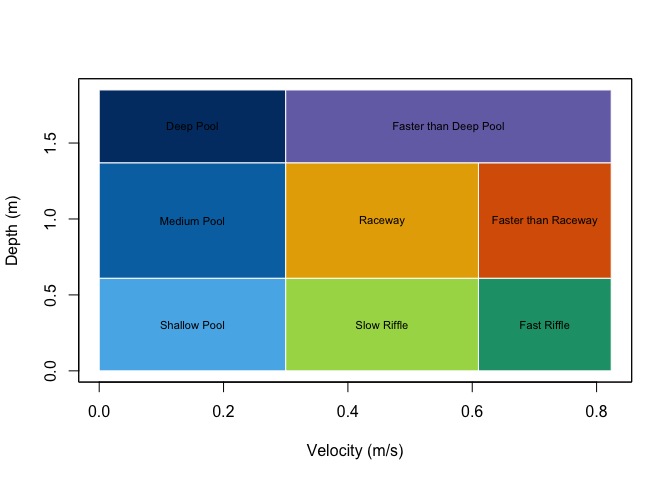
classify_mesohabitat_values(
  depth = c(0, 0.61, 1.37, NA),
  velocity = c(0, 0.30, 0.61, 0.2)
)
#>   depth velocity mesohabitat_class           mesohabitat
#> 1  0.00     0.00                 1          Shallow Pool
#> 2  0.61     0.30                 6               Raceway
#> 3  1.37     0.61                 8 Faster than Deep Pool
#> 4    NA     0.20                NA                  <NA>
classified <- classify_mesohabitat_table(
hydromeso_example, "depth", "velocity"
)
head(classified)
#> x y depth velocity mesohabitat_class mesohabitat
#> 1 500000 4400000 0.2 0.1 1 Shallow Pool
#> 2 500010 4400010 0.8 0.1 2 Medium Pool
#> 3 500020 4400020 1.5 0.1 3 Deep Pool
#> 4 500030 4400030 0.2 0.4 4 Slow Riffle
#> 5 500040 4400040 0.2 0.8 5 Fast Riffle
#> 6 500050 4400050 0.8 0.4 6 Raceway
summarize_mesohabitat(classified)
#> class_id label record_count percentage missing_count
#> 1 1 Shallow Pool 3 17.647059 1
#> 2 2 Medium Pool 3 17.647059 1
#> 3 3 Deep Pool 2 11.764706 1
#> 4 4 Slow Riffle 2 11.764706 1
#> 5 5 Fast Riffle 2 11.764706 1
#> 6 6 Raceway 2 11.764706 1
#> 7 7 Faster than Raceway 2 11.764706 1
#> 8 8 Faster than Deep Pool 1 5.882353 1points <- mesohabitat_example_vector()
classified_points <- classify_mesohabitat_vector(points, "depth", "velocity")
classified_points
#> class : SpatVector
#> geometry : points
#> dimensions : 18, 4 (geometries, attributes)
#> extent : 500000, 500170, 4400000, 4400170 (xmin, xmax, ymin, ymax)
#> coord. ref. : WGS 84 / UTM zone 15N (EPSG:32615)
#> names : depth velocity mesohabitat_class mesohabitat
#> type : <num> <num> <int> <chr>
#> values : 0.2 0.1 1 Shallow Pool
#> 0.8 0.1 2 Medium Pool
#> 1.5 0.1 3 Deep Pool
#> ...hydraulics <- mesohabitat_example_rasters()
classes <- classify_mesohabitat_raster(hydraulics$depth, hydraulics$velocity)
classes
#> class : SpatRaster
#> size : 230, 445, 1 (nrow, ncol, nlyr)
#> resolution : 18, 18 (x, y)
#> extent : 1725550, 1733560, 312049.5, 316189.5 (xmin, xmax, ymin, ymax)
#> coord. ref. : +proj=lcc +lat_0=38.3333333333333 +lon_0=-98 +lat_1=38.7166666666667 +lat_2=39.7833333333333 +x_0=400000 +y_0=0 +ellps=GRS80 +units=us-ft +no_defs
#> source(s) : memory
#> categories : mesohabitat
#> name : mesohabitat
#> min value : Shallow Pool
#> max value : Faster than Deep Pool
summarize_mesohabitat(classes)
#> scenario class_id label cell_count area_m2 hectares
#> 1 mesohabitat 1 Shallow Pool 470 14148.535 1.4148535
#> 2 mesohabitat 2 Medium Pool 205 6171.170 0.6171170
#> 3 mesohabitat 3 Deep Pool 130 3913.425 0.3913425
#> 4 mesohabitat 4 Slow Riffle 823 24774.986 2.4774986
#> 5 mesohabitat 5 Fast Riffle 115 3461.876 0.3461876
#> 6 mesohabitat 6 Raceway 1036 31186.982 3.1186982
#> 7 mesohabitat 7 Faster than Raceway 3951 118937.996 11.8937996
#> 8 mesohabitat 8 Faster than Deep Pool 14604 439628.086 43.9628086
#> square_kilometres acres percentage
#> 1 0.014148535 3.4961791 2.2030562
#> 2 0.006171170 1.5249293 0.9609076
#> 3 0.003913425 0.9670284 0.6093560
#> 4 0.024774986 6.1220325 3.8576918
#> 5 0.003461876 0.8554481 0.5390457
#> 6 0.031186982 7.7064710 4.8560981
#> 7 0.118937996 29.3902190 18.5197332
#> 8 0.439628086 108.6344659 68.4541114Custom schemes use the same engine:
rules <- data.frame(
  class_id = c(1L, 2L), label = c("Slow", "Fast"),
  depth_min = c(0, 0), depth_max = c(Inf, Inf),
  velocity_min = c(0, 0.5), velocity_max = c(0.5, Inf)
)
custom <- meso_scheme(rules, name = "Two velocity classes")
classify_mesohabitat_values(c(0.2, 1), c(0.2, 0.8), custom)
#>   depth velocity mesohabitat_class mesohabitat
#> 1   0.2      0.2                 1        Slow
#> 2 1.0 0.8 2 FastThe output is a depth-velocity hydraulic classification, not proof of
habitat quality or fish occupancy. Interpretation depends on species and
life stage, stream type, substrate, cover, connectivity, water quality,
temperature, flow regime, hydraulic-model resolution, and local
validation. Class IDs are labels, not ordinal scores. Users must decide
how dry cells are represented in their own HEC-RAS or other model
outputs; dry_threshold = NULL preserves the exact scheme
and classifies zero depth and zero velocity as Class 1.
The default eight-class table is from Cordero and Harris (Preprint),
Semi-Supervised and Supervised Machine Learning Approaches to
Predicting Fluvial Mesohabitats from Satellite Data, DOI:
10.2139/ssrn.7100727. The broader framework is informed by
Aadland (1993), Stream Habitat Types: Their Fish Assemblages and
Relationship to Flow, DOI:
10.1577/1548-8675(1993)013<0790:SHTTFA>2.3.CO;2.
Source code and issue tracking are available at github.com/el-cordero/hydromeso.
These binaries (installable software) and packages are in development.
They may not be fully stable and should be used with caution. We make no claims about them.
Health stats visible at Monitor.