
The hardware and bandwidth for this mirror is donated by dogado GmbH, the Webhosting and Full Service-Cloud Provider. Check out our Wordpress Tutorial.
If you wish to report a bug, or if you are interested in having us mirror your free-software or open-source project, please feel free to contact us at mirror[@]dogado.de.



The package funbiogeo aims to help users with analyses
in functional biogeography (Violle et al.
2014), the biogeography of species’ traits, by loading and combining
data, exploring the relationships between traits and their availability
trait coverage, providing many diagnostic plots to understand how to
filter them, producing maps, correlating them with the environment, and
helping to aggregate data at different scales. It is aimed at
first-timers of functional biogeography as well as more experienced
users who want to obtain quick and easy exploratory plots.
Below is a quick introduction to the main features of
funbiogeo. If you want some more details about them, check
our vignettes.
funbiogeo offers:
betapart,
fundiversity, hillR, mFD,
etc.),
Naming scheme of available functions in funbiogeo
For the moment funbiogeo is not on CRAN but you can
install the development version from R-universe as follows:
install.packages("funbiogeo", repos = c("https://frbcesab.r-universe.dev", "https://cloud.r-project.org"))This section will show you some useful functions from
funbiogeo. For a longer introduction, please refer to the
“Introduction”
vignette.
The package contains default example data named
woodiv_traits, woodiv_site_species, and
woodiv_locations all from the WOODIV database (Monnet et al. 2021). You can, for example,
visualize the completeness of your trait dataset (which traits are known
for which proportion of species) using the
fb_plot_species_traits_completeness() function:
fb_plot_species_traits_completeness(woodiv_traits)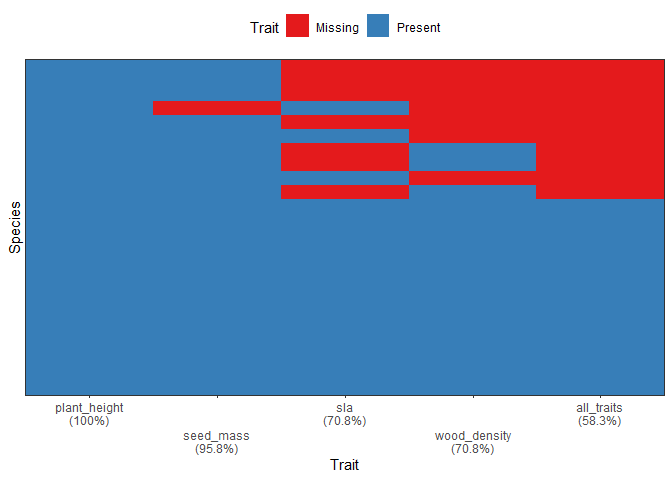
One other useful visualization is to see the trait coverage of each
trait across all sites, using the function
fb_map_site_traits_completeness():
fb_map_site_traits_completeness(woodiv_locations, woodiv_site_species, woodiv_traits)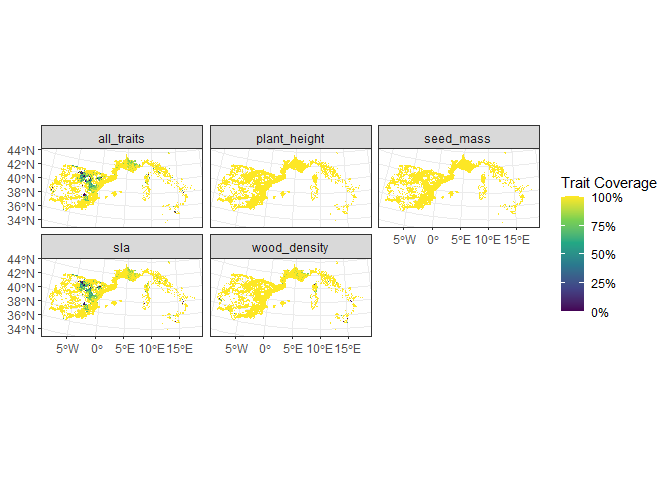
All of the features of funbiogeo are presented through
the vignettes
of the package.
funbiogeo provides five vignettes to explain its
functioning:
funbiogeo that describes its core features and
guides you through a typical analysis.funbiogeo needs, which shows you the use of
specific functions to format your data to work well within
funbiogeo.funbiogeo to
automatically aggregate your data to a coarser resolution and use it in
subsequent analyses.At the moment, funbiogeo doesn’t offer a companion paper
nor is it on CRAN. But if you happen to use it in your paper, you can
cite the package through:
Casajus N & Grenié M (2026) funbiogeo: Streamlining Functional Biogeography Analyses. R package version 0.0.1, https://github.com/frbcesab/funbiogeo/.
You can also run:
citation("funbiogeo")All types of contributions are encouraged and valued. For more information, check out our Contributor Guidelines.
Please note that the funbiogeo project is released with
a Contributor
Code of Conduct. By contributing to this project, you agree to abide
by its terms.
This package has been developed for the FRB-CESAB working group FREE and its followup FREE 2 which aims to advance the concept of functional rarity and examine the causes and consequences of functional rarity from local to global scales.
Monnet, AC., Cilleros, K., Médail, F. et al. WOODIV, a database of occurrences, functional traits, and phylogenetic data for all Euro-Mediterranean trees. Sci Data 8, 89 (2021). DOI: 10.1038/s41597-021-00873-3
Violle C, Reich, PB Pacala SW, et al. (2014) The emergence and promise of functional biogeography. Proceedings of the National Academy of Sciences, 111, 13690-13696. DOI: 10.1073/pnas.1415442111
These binaries (installable software) and packages are in development.
They may not be fully stable and should be used with caution. We make no claims about them.
Health stats visible at Monitor.