The hardware and bandwidth for this mirror is donated by dogado GmbH, the Webhosting and Full Service-Cloud Provider. Check out our Wordpress Tutorial.
If you wish to report a bug, or if you are interested in having us mirror your free-software or open-source project, please feel free to contact us at mirror[@]dogado.de.
fda.vi is an R package that implements a variational expectation-maximization (VEM) algorithm for smoothing one or multiple functional observations via basis function selection. The algorithm estimates all model parameters simultaneously and automatically, while accounting for within-curve correlation. It provides a fast, scalable alternative to Bayesian sampling-based MCMC methods for smoothing functional curves with within-curve correlated errors via an Ornstein-Uhlenbeck covariance function.
The details of the variational EM algorithm can be found in da Cruz, de Souza and Sousa (2024).
# install.packages("pak")
pak::pak("desouzalab/fda.vi")library(fda.vi)
data(toy_curves)
fit <- vem_fit(
y = toy_curves$y,
Xt = toy_curves$Xt,
K = 8,
center = FALSE,
scale = FALSE
)summary(fit)
#> ------------------------------------------------
#> VEM Smooth Fit Summary
#> ------------------------------------------------
#> Basis Type cubic_bspline
#> Curves (m): 3
#> Basis Functions (K): 8
#> Active Bases (per curve): 6, 6, 6
#>
#> Model Parameters (Representative):
#> Point estimate for decay parameter (w): 6.217
#>
#> Posterior q(sigma^2) ~ IG(delta1, delta2):
#> delta1 (shape): 97
#> delta2 (scale): 0.859869
#>
#> Posterior q(tau^2) ~ IG(lambda1, lambda2):
#> lambda1 (shape): 12.001
#> lambda2 (scale): 1517.36
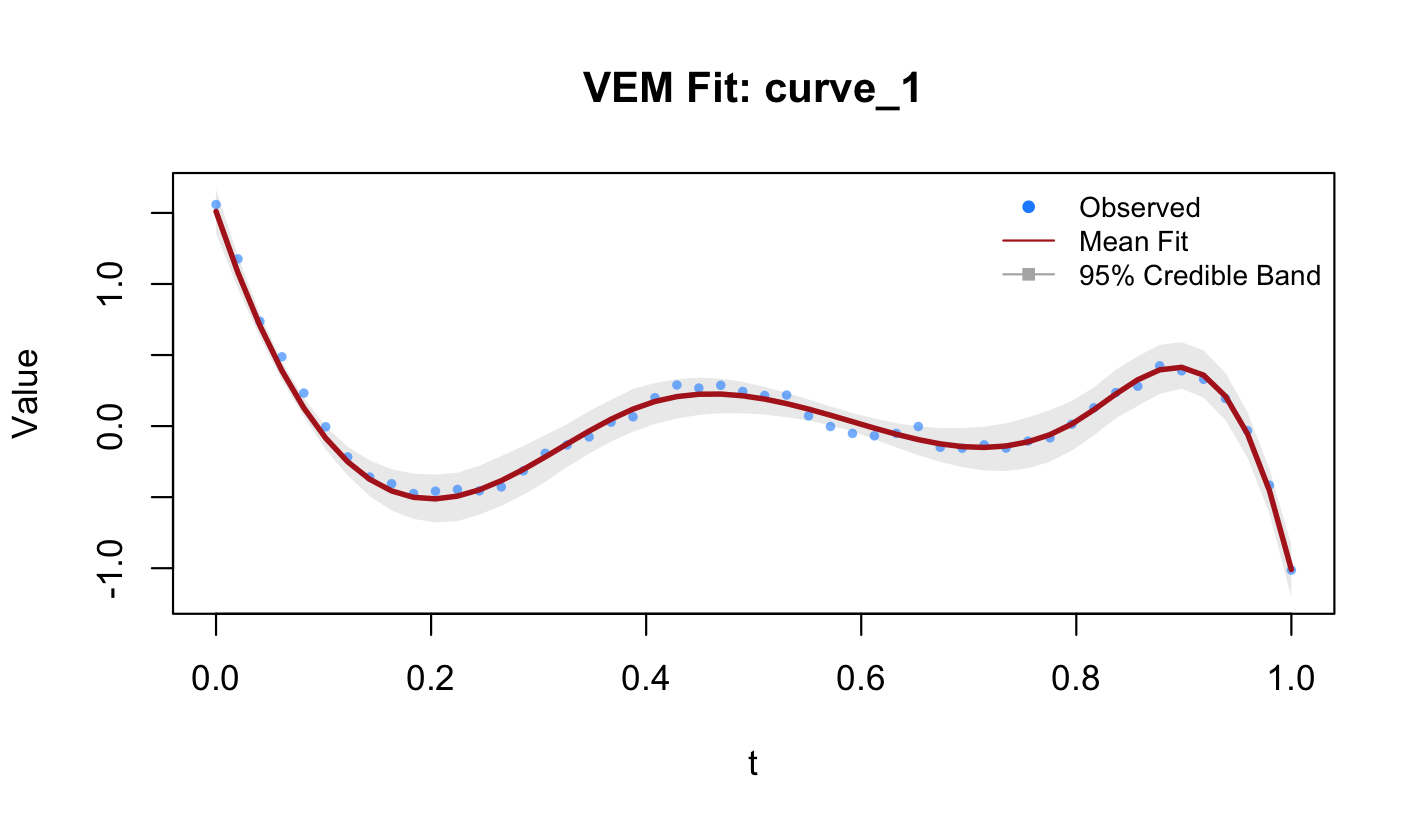
#> ------------------------------------------------plot(fit, curve_idx = 1)
coef(fit)
#>      Curve_1    Curve_2    Curve_3
#> B1  1.5105434  1.6158541  1.5027916
#> B2  0.0000000  0.0000000  0.0000000
#> B3 -1.0173887 -1.1296271 -0.9889452
#> B4  0.4855913  0.7182764  0.8098905
#> B5  0.0000000  0.0000000  0.0000000
#> B6 -0.4088634 -0.7414497 -0.5324928
#> B7  1.0851575  1.1127756  1.2152763
#> B8 -1.0093923 -1.1186148 -0.9470451
Xt_new <- seq(0, 1, length.out = 200)
y_pred <- predict(fit, newdata = Xt_new)
head(y_pred[[1]])
#> [1] 1.5105434 1.3985729 1.2903498 1.1858269 1.0849569 0.9876925plot(),
predict(), coef(), and summary()
methods for fitted objectsda Cruz, A. C., de Souza, C. P. E., & Sousa, P. H. T. O. (2024). Fast Bayesian basis selection for functional data representation with correlated errors. arXiv:2405.20758. https://arxiv.org/abs/2405.20758
To cite the method implemented in this package, please use:
da Cruz, A. C., de Souza, C. P. E., & Sousa, P. H. T. O. (2024). Fast Bayesian basis selection for functional data representation with correlated errors. arXiv:2405.20758. https://arxiv.org/abs/2405.20758
@misc{dacruz2024vem,
  title     = {Fast {Bayesian} basis selection for functional data
               representation with correlated errors},
  author    = {da Cruz, Ana Carolina and de Souza, Camila P. E. and
               Sousa, Pedro H. T. O.},
  year      = {2024},
  note      = {arXiv:2405.20758},
  url       = {https://arxiv.org/abs/2405.20758}
}
These binaries (installable software) and packages are in development.
They may not be fully stable and should be used with caution. We make no claims about them.
Health stats visible at Monitor.