

The hardware and bandwidth for this mirror is donated by dogado GmbH, the Webhosting and Full Service-Cloud Provider. Check out our Wordpress Tutorial.
If you wish to report a bug, or if you are interested in having us mirror your free-software or open-source project, please feel free to contact us at mirror[@]dogado.de.



clim4health is an R package designed to obtain, transform and export climate data for their use in epidemiological analyses and other types of applications. The package contains a series of functions structured in three sequential blocks: input, transformation, and output.
In the input block, clim4health provides functions to download several types of climate data including reanalyses, seasonal forecasts and hindcasts, and weather stations and load them into memory for their processing. The transformation block includes functions to downscale and verify climate data, perform spatiotemporal aggregations, as well as compute threshold-based suitability indicators. Finally, in the output block, functions to visualise and export the transformed data are provided.
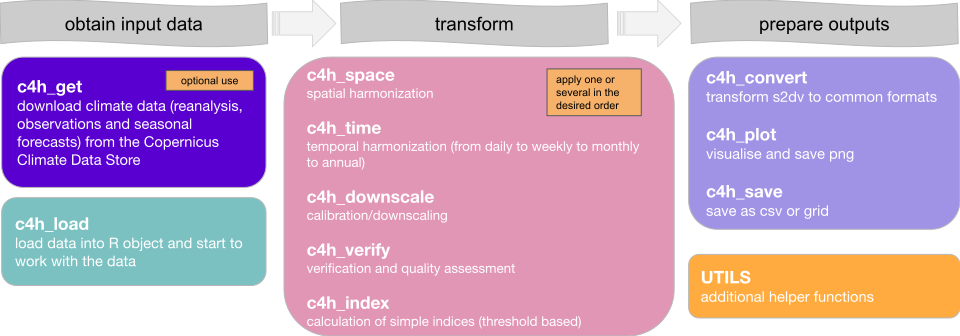
clim4health is one of the packages developed by the Global Health Resilience (GHR) team at the Barcelona Supercomputing Center (BSC) within the HARMONIZE project, which comprises different R and Python libraries tailored for health, climate, environmental, and socioeconomic data acquisition, harmonisation, and visualization.
More information about the R packages developed at GHR for climate and health workflows and an online version of the package documentation can be found at the GHR tools website.
# Install from CRAN
install.packages("clim4health")

# Get the development version from Gitlab
devtools::install_git('https://earth.bsc.es/gitlab/ghr/clim4health.git')# Load climate reanalysis temperature data included in the package
# and plot it for the study area
library("clim4health")
library("sf")
# Region municipalities
mun_path <- system.file("extdata", "areas", "munip_vallecauca.gpkg",
package = "clim4health")
mun <- read_sf(mun_path)
# Reanalysis data
rean_path <- system.file("extdata", "reanalysis", package = "clim4health")
rean <- c4h_load(rean_path, variable = "t2m", ext = 'nc')
# Convert units
rean <- c4h_convert_units(rean, to = "celsius")
# clim4health plot
c4h_plot(rean,
boundaries = mun,
mask_boundaries = TRUE,
coordgrid = TRUE)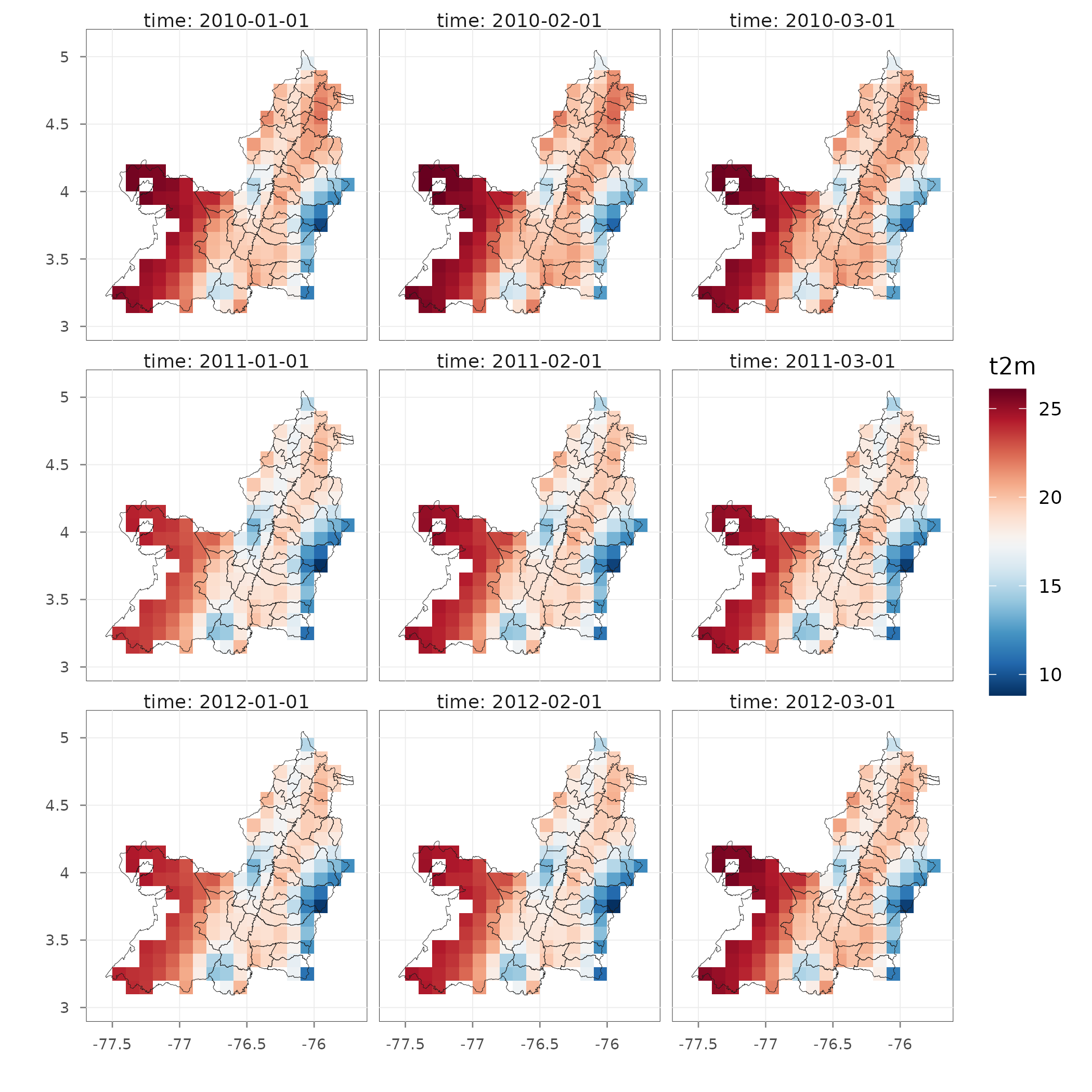
Several vignettes are available to explore
clim4health. Vignettes loaded in the package can be
accessed in R by typing vignette("vignettename") (e.g.,
vignette("clim4health_overview")).
The vignettes are: - "clim4health_overview": a general
introduction to the main functionalities of the package, including a
worked example. - "clim4health_get": an introduction to
using c4h_get() to download data from the Copernicus
Climate Data Store. - "clim4health_glossary": a glossary of
terms related to climate data, postprocessing, and verification,
relevant within the clim4health package. -
"clim4health_s2dv_cubes": an introduction to the data class
used within clim4health, and how to create your own object of this class
if needed. - "clim4health_downscaling": an introduction to
downscaling methodologies and how they are applied within clim4health. -
"clim4health_verification": a guide to different
verification metrics for seasonal forecasts and how they are calculated
within the package.
Emily Ball,
PhD

Barcelona Supercomputing Center
Climate Services Team
Carles Milà,
PhD
Barcelona Supercomputing Center
Global Health Resilience
Alba Llabrés, PhD
Barcelona Supercomputing Center
Climate Services Team
Raúl Capellán Fernández, MSc
Barcelona Supercomputing Center
Earth Data and Diagnostics
Rebeca
Nunes, MSc
Barcelona Supercomputing Center
Earth Data and Diagnostics
Daniela
Lührsen, MSc
Barcelona Supercomputing Center
Global Health Resilience
Anna B.
Kawiecki, PhD
Barcelona Supercomputing Center
Global Health Resilience
Rachel Lowe,
PhD
Barcelona Supercomputing Center
Global Health Resilience (Group leader)
These binaries (installable software) and packages are in development.
They may not be fully stable and should be used with caution. We make no claims about them.
Health stats visible at Monitor.