The hardware and bandwidth for this mirror is donated by dogado GmbH, the Webhosting and Full Service-Cloud Provider. Check out our Wordpress Tutorial.
If you wish to report a bug, or if you are interested in having us mirror your free-software or open-source project, please feel free to contact us at mirror[@]dogado.de.
CEACT (Cost-Effectiveness Analysis for Clinical Trials) is an R package for two-arm trial-based economic evaluation. It implements a formula-based workflow for:
observed incremental cost, incremental effect, and ICER summaries;
stratified non-parametric bootstrap uncertainty;
incremental net monetary benefit (INMB);
cost-effectiveness acceptability curves (CEACs);
cost-effectiveness planes;
one-way deterministic sensitivity analysis;
missing cost and effect data, through Rubin’s rules on multiply
imputed data (micea()) or bootstrap-then-impute resampling
(miboot()).
CEACT is intended for individual-level clinical-trial datasets with one cost variable, one effect variable, and a two-level treatment group.
Install the released version from CRAN:
install.packages("CEACT")Or the development version from GitHub:
# install.packages("remotes")
remotes::install_github("ielbadisy/CEACT")library(CEACT)trial <- simulatecetrial(n = 200, seed = 123)
head(trial)
#> # basetable: 6 x 3
#> cost effect group
#> 1 4495.572 0.9289862 control
#> 2 4792.840 0.8463038 control
#> 3 6402.837 0.7171661 control
#> 4 5063.458 0.7747625 control
#> 5 5116.359 0.6809741 control
#> 6 6543.558 0.6986401 controlres_cea <- cea(cost + effect ~ group, data = trial, ref = "control")
summary(res_cea)
#> Cost-Effectiveness Summary
#> Formula: cost + effect ~ group
#> Reference group: control
#> Treatment group: treatment
#> Incremental cost: 639.489
#> Incremental effect: 0.054
#> ICER: 11818.69
#>
#> Outcome Reference Treatment Difference
#> delta_cost Cost 4992.287 (SD 848.844) 5631.775 (SD 964.805) 639.489
#> delta_effect Effect 0.724 (SD 0.099) 0.778 (SD 0.113) 0.054
#> CI p.value
#> delta_cost [460.84; 818.138] <0.001
#> delta_effect [0.033; 0.075] <0.001set.seed(42)
res_boot <- booticer(cost + effect ~ group, data = trial, ref = "control",
R = 500, ci.type = "perc")
summary(res_boot)
#> # basetable: 3 x 6
#> Metric Observed BootstrapMean StdError Bias CI
#> 1 Delta Cost 639.489 634.728 90.584 -4.761 [455.471; 810.055]
#> 2 Delta Effect 0.054 0.054 0.010 -0.001 [0.033; 0.073]
#> 3 ICER 11818.694 NA NA NA [7593.238; 18788.674]plotceplane(res_boot, k = 20000)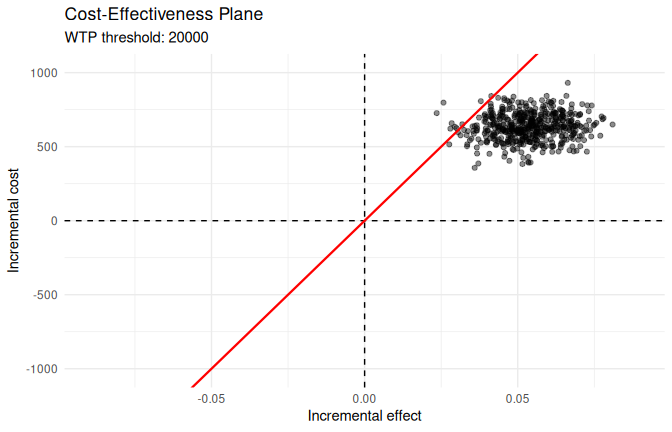
ceac_table <- computenmbceac(res_boot, wtp_range = seq(0, 50000, 5000))
head(ceac_table)
#> # basetable: 6 x 3
#>     WTP       ENMB Prob_CE
#> 1     0 -639.48888   0.000
#> 2  5000 -368.94762   0.000
#> 3 10000  -98.40636   0.224
#> 4 15000  172.13490   0.826
#> 5 20000  442.67616   0.982
#> 6 25000  713.21742   0.996
plotceac(ceac_table)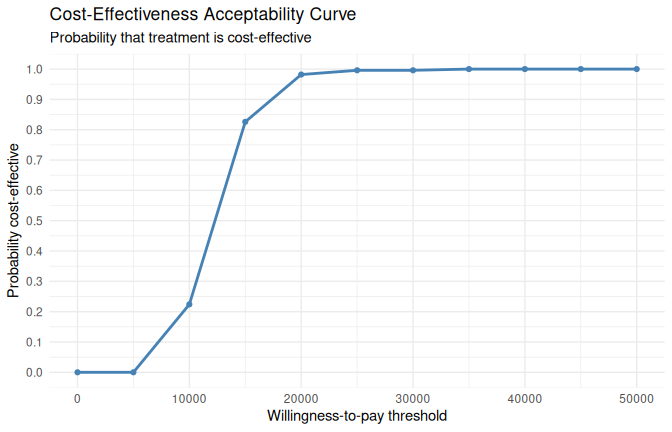
dsa_result <- dsaicer(cost + effect ~ group, data = trial,
                       param = "effect",
                       range = seq(0.74, 0.82, 0.02),
                       ref = "control",
                       metric = "INMB",
                       k = 20000)
dsa_result
#> # basetable: 5 x 2
#>   Parameter       INMB
#> 1      0.74 -320.20684
#> 2      0.76   79.79316
#> 3      0.78  479.79316
#> 4      0.80  879.79316
#> 5      0.82 1279.79316
plotdsa(dsa_result, metric = "INMB")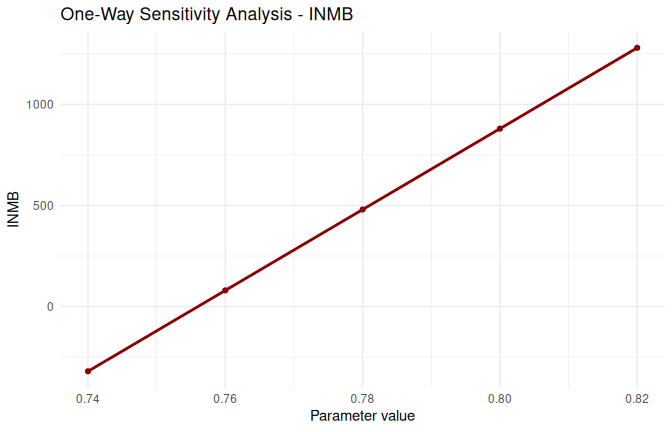
Trial costs and effects are often incomplete. micea()
runs the analysis in each completed data set and pools the incremental
cost, incremental effect, and INMB with Rubin’s rules (Barnard-Rubin
degrees of freedom). It accepts a mimar_imputation (from
mimar::impute()), a mids (from
mice::mice()), or a plain list of completed data frames.
The pooled CEAC table works with plotceac().
set.seed(1)
trial_mis <- trial
trial_mis$cost[sample(nrow(trial_mis), 50)] <- NA

imp <- mimar::impute(trial_mis, m = 5, seed = 1)
res_mi <- micea(cost + effect ~ group, data = imp, ref = "control",
                wtp_range = seq(0, 50000, 5000))
res_mi
#> Cost-effectiveness analysis pooled over 5 imputations
#> Reference: control; treatment: treatment; n = 400
#>
#> # basetable: 3 x 7
#>        Metric  Estimate StdError   Lower   Upper      df   FMI
#>    Delta Cost   661.826   92.720 479.342 844.311 291.696 0.061
#>  Delta Effect     0.054    0.011   0.033   0.075 398.000 0.000
#>          ICER 12231.525       NA      NA      NA      NA    NA
plotceac(res_mi$ceac)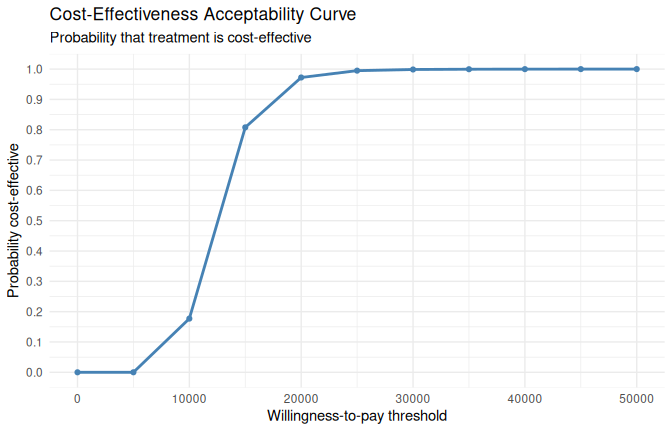
miboot() bootstraps first and imputes every bootstrap
sample with a user-supplied function (Brand et al. 2019). The result is
a booticer-compatible object, so
computenmbceac(), plotceplane(), and
plotceac() work unchanged.
impute_fun <- function(d) mimar::impute(d, m = 2)
res_miboot <- miboot(cost + effect ~ group, data = trial_mis, ref = "control",
                     imputefun = impute_fun, R = 100, seed = 1)
summary(res_miboot)
#> # basetable: 3 x 6
#>         Metric  Observed BootstrapMean StdError    Bias                    CI
#> 1   Delta Cost   686.372       659.151   98.374 -27.221    [462.925; 847.301]
#> 2 Delta Effect     0.054         0.057    0.010   0.003         [0.04; 0.081]
#> 3         ICER 12685.162            NA       NA      NA [7792.656; 16950.597]
plotceplane(res_miboot, k = 20000)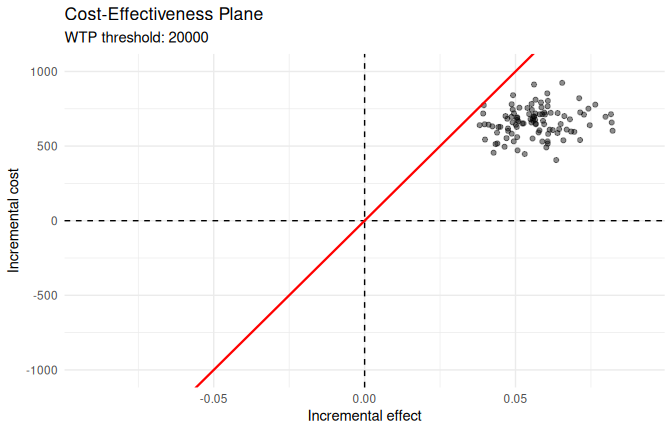
Both functions take an optional weights argument naming
a case-weight column (for example matching or inverse probability
weights computed within each completed data set).
CEACT also includes trial_cea, a 500-patient example
dataset with treatment, total cost, and QALY outcomes used in teaching
material for trial-based economic evaluation.
data("trial_cea")
real_res <- cea(cost + qaly ~ group, data = trial_cea, ref = "control")
summary(real_res)
#> Cost-Effectiveness Summary
#> Formula: cost + qaly ~ group
#> Reference group: control
#> Treatment group: treatment
#> Incremental cost: 25
#> Incremental effect: 0.042
#> ICER: 588.802
#>
#>              Outcome          Reference          Treatment Difference
#> delta_cost      Cost 3015 (SD 1582.802) 3040 (SD 1168.737)     25.000
#> delta_effect  Effect   0.573 (SD 0.217)   0.615 (SD 0.205)      0.042
#>                             CI p.value
#> delta_cost   [-219.54; 269.54]  0.8409
#> delta_effect [0.005; 0.08] 0.0251Unit tests are implemented with testthat.
Function documentation is generated with roxygen2.
A PDF vignette is available in vignettes/.
The package source builds and checks successfully with
R CMD check.
These binaries (installable software) and packages are in development.
They may not be fully stable and should be used with caution. We make no claims about them.
Health stats visible at Monitor.